


Page 104 - EJMO-9-1
P. 104
Eurasian Journal of Medicine and
            Oncology
                                                                         Genomics of breast cancer in Western Kazakhstan


            Table 1. (Continued)
            No.       Polymorphism (SNP)    Genotype             Group  (%)            Total       P‑value (df=1)
                                                                      a
                                                             BC          Control
            20        Rs1800058             CC             97 (67.83)    63 (47.37)     160          0.0022
                                            CT             45 (31.47)    67 (50.38)     112
                                            TT             1 (0.70)       3 (2.26)       4
            21        Rs1799950             TT            129 (90.21)    146 (97.33)    275          0.0111
                                            CT             14 (9.79)     4 (2.67%)      18
            22        Rs1799954             CC            109 (73.15)    87 (58.00)     196          0.0058
                                            CT             40 (26.85)    63 (42.00)     103
            23        Rs889312              AC             83 (56.08)    86 (57.33)     169          0.0131
                                            AA             28 (18.92)    44 (29.33)     72
                                            CC             37 (25.00)    20 (13.33)     57
            24        Rs1787991             GG             75 (67.57)    74 (53.24)     149          0.0308
                                            GT             35 (31.53)    65 (46.76)     100
                                            TT             1 (0.90)       0 (0.00)*      1
            25        Rs3918242             TT             90 (62.50)    73 (50.34)     163          0.0372
                                            TC             54 (37.50)    72 (49.66)     126
            26        Rs62625308            GG            109 (73.15)    88 (58.67)     197          0.0082
                                            GA             40 (26.85)    62 (41.33)     102
            27        Rs757229              GC             72 (48.98)    37 (24.67)     109          <0.0001
                                            CC             51 (34.69)    52 (34.67)     103
                                            GG             24 (16.33)    61 (40.67)     85
            28        Rs7895676             TT             91 (63.64)    75 (51.02)     166          0.0299
                                            TC             52 (36.36)    72 (48.98)     124
                a
            Note:  All data are expressed as n (%), unless otherwise stated. *indicates that the genotype was assessed but not observed in the group.
            Abbreviations: BC: Breast cancer; df: Degree of freedom; SNP: Single nucleotide polymorphism.

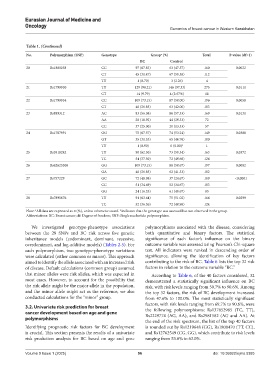
              We investigated genotype-phenotype associations   polymorphisms associated with the disease, considering
            between the 28 SNPs and BC risk across five genetic   both quantitative and binary factors. The statistical
            inheritance models (codominant, dominant, recessive,   significance of each factor’s influence on the binary
            overdominant, and log-additive models) (Tables 2‑5). For   outcome variable was assessed using Pearson’s Chi-square
            each polymorphism,  two genotype-phenotype variations   test.  All  indicators were  ranked in  descending order  of
            were calculated (either common or minor). This approach   significance, allowing  the identification  of key factors
            aimed to identify the allele associated with an increased risk   contributing to the risk of BC. Table 6 lists the top 32 risk
            of disease. Default calculations (common group) assumed   factors in relation to the outcome variable “BC.”
            that minor alleles were risk alleles, which was expected in   According to Table 6, of the 40 factors considered, 32
            most cases. However, to account for the possibility that   demonstrated a  statistically significant  influence on BC
            the risk allele might be the major allele in the population,   risk, with risk levels ranging from 50.7% to 90.6%. Among
            and the minor allele might act as the reference, we also   the top 32 factors, the risk of BC development increased
            conducted calculations for the “minor” group.      from 47.6% to 100.0%. The most statistically significant
                                                               factors, with risk levels ranging from 69.7% to 90.6%, were
            3.2. Univariate risk prediction for breast         the following polymorphisms: Rs137852985 (TC, TT),
            cancer development based on age and gene           Rs2229774 (AG, AA), and Rs2981582 (AG and AA). At
            polymorphisms                                      the end of the risk spectrum, the list of the top 40 factors
            Identifying prognostic risk factors for BC development   is rounded out by Rs1219648 (GG), Rs1800470 (TT, CC),
            is crucial. This section presents the results of a univariate   and Rs12762549 (CG, GG), which contribute to risk levels
            risk  prediction  analysis for BC  based on age  and gene   ranging from 53.0% to 63.0%.


            Volume 9 Issue 1 (2025)                         96                              doi: 10.36922/ejmo.5385

