


Page 108 - EJMO-9-1
P. 108
Eurasian Journal of Medicine and
            Oncology
                                                                         Genomics of breast cancer in Western Kazakhstan


            Table 7. Patient risk classes for the target indicator “breast cancer,” sorted by descending risk
            No.                     Class definition                Group size     Class proportion, %  Risk, %
            1         Rs137852985 (TC, TT) & Rs2981582 (AA, GG)        20               7.3             100.0
            2         Rs137852985 (TC, TT) & Rs2981582 (AG)            86               31.3             88.4
            3         Rs137852985 (CC) & Rs757229 (GC) & age ≥56.0 years  30            10.9             50.0
            4         Rs137852985 (CC) & Rs757229 (GC) & age years <56.0  30            10.9             30.0
            5         Rs137852985 (CC) & Rs757229 (CC, GG) & age 49.0 years  62         22.5             14.5
            6         Rs137852985 (CC) & Rs757229 (CC, GG) & age <49.0 years  47        17.1             0.0


            Table 8. Predictive quality indicators of the constructed
            decision tree for the target outcome “breast cancer” based on
            risk polymorphisms identified in the current study
            Metric                                   Value
            Cutoff point                             50.0%
            AuROC                                     0.95
            Sensitivity                              86.0%
            Specificity                              92.4%
            Effectiveness                            89.2%
            Abbreviation: AuROC: Area under the receiver operating characteristic
            curve.

            level, was defined by the  combination of Rs137852985
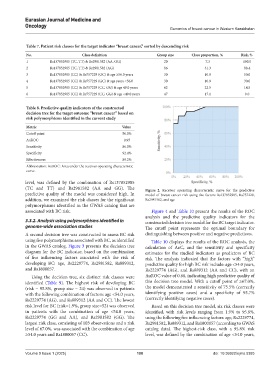
            (TC and TT) and Rs2981582 (AA and GG). The         Figure  2. Receiver operating characteristic curve for the predictive
            predictive quality of the model was considered high. In   model of breast cancer risk using the factors Rs137852985, Rs757229,
            addition, we examined the risk classes for the significant   Rs2981582, and age
            polymorphisms identified in the GWAS catalog that are
            associated with BC risk.                             Figure 4 and Table 10 present the results of the ROC
                                                               analysis and the predictive quality indicators for the
            3.3.2. Analysis using polymorphisms identified in   constructed decision tree model for the BC target indicator.
            genome-wide association studies                    The  cutoff  point  represents  the  optimal  boundary  for

            A second decision tree was constructed to assess BC risk   distinguishing between positive and negative predictions.
            using five polymorphisms associated with BC, as identified   Table 10 displays the results of the ROC analysis, the
            in the GWAS catalog. Figure 3 presents the decision tree   calculation of AuC, and the sensitivity and specificity
            diagram for the BC indicator, based on the combination   estimates for the studied indicators as predictors of BC
            of five influencing factors associated with the risk of   risk. The analysis indicated that the factors with “high”
            developing BC: age, Rs2229774, Rs2981582, Rs889312,   predictive quality for high BC risk include: age <54.0 years,
            and Rs1800057.                                     Rs2229774 (AG), and Rs889312 (AA and CC), with an
              Using  the decision tree,  six distinct  risk classes were   AuROC value of 0.88, indicating high predictive quality of
            identified (Table 9). The highest risk of developing BC   this decision tree model. With a cutoff point of ≥67.0%,
            (risk = 95.8%, group size = 24) was observed in patients   the model demonstrated a sensitivity of 75.5% (correctly
            with the following combination of factors: age <54.0 years,   identifying  positive  cases)  and  a  specificity  of  93.7%
            Rs2229774 (AG), and Rs889312 (AA and CC). The lowest   (correctly identifying negative cases).
            risk level for BC (risk=1.9%, group size=52) was observed   Based on this decision tree model, six risk classes were
            in patients with the combination of age <54.0  years,   identified, with risk levels ranging from 1.9% to 95.8%,
            Rs2229774 (GG and AA), and Rs2981582 (GG). The     using the following five influencing factors: age, Rs2229774,
            largest risk class, consisting of 103 observations and a risk   Rs2981582, Rs889312, and Rs1800057 (according to GWAS
            level of 67.0%, was associated with the combination of age   catalog  data). The  highest-risk  class,  with a  95.8% risk
            ≥54.0 years and Rs1800057 (CC).                    level, was defined by the combination of age <54.0 years,


            Volume 9 Issue 1 (2025)                        100                              doi: 10.36922/ejmo.5385

