


Page 109 - EJMO-9-1
P. 109
Eurasian Journal of Medicine and
            Oncology
                                                                         Genomics of breast cancer in Western Kazakhstan


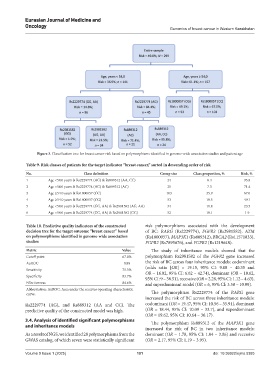
                 Figure 3. Classification tree for breast cancer risk based on polymorphisms identified in genome-wide association studies and patient age

            Table 9. Risk classes of patients for the target indicator “breast cancer,” sorted in descending order of risk
            No.                      Class definition                Group size    Class proportion, %  Risk, %
            1         Age <54.0 years & Rs2229774 (AG) & Rs889312 (AA, CC)  24           8.4             95.8
            2         Age <54.0 years & Rs2229774 (AG) & Rs889312 (AC)  21               7.3             71.4
            3         Age ≥54.0 years & Rs1800057 (CC)                  103              35.9            67.0
            4         Age ≥54.0 years & Rs1800057 (CG)                  53               18.5            49.1
            5         Age <54.0 years & Rs2229774 (GG, AA) & Rs2981582 (AG, AA)  34      11.8            23.5
            6         Age <54.0 years & Rs2229774 (GG, AA) & Rs2981582 (GG)  52          18.1            1.9

            Table 10. Predictive quality indicators of the constructed   risk polymorphisms associated with the development
            decision tree for the target outcome “breast cancer” based   of BC:  RARG (Rs2229774),  FGFR2 (Rs2981582),  ATM
            on polymorphisms identified in genome‑wide association   (Rs1800057), MAP3K1 (Rs889312), BRCA2 (Rs11571833),
            studies                                            FGFR2 (Rs7895676), and FGFR2 (Rs1219648).

            Metric                                   Value       The study of inheritance models showed that the
            Cutoff point                             67.0%     polymorphism Rs2981582 of the  FGFR2  gene increased
            AuROC                                     0.88     the risk of BC across four inheritance models: codominant
            Sensitivity                              75.5%     (odds ratio [OR] = 19.15, 95% CI: 9.08 – 40.35 and
                                                               OR = 16.82, 95% CI: 6.62 – 42.74), dominant (OR = 18.62,
            Specificity                              93.7%     95% CI: 9 – 38.51), recessive (OR = 2.28, 95% CI: 1.12 – 4.63),
            Effectiveness                            84.6%     and superdominant model (OR = 6, 95% CI: 3.58 – 10.09).
            Abbreviation: AuROC: Area under the receiver operating characteristic
            curve.                                               The polymorphism Rs2229774 of the  RARG gene
                                                               increased the risk of BC across three inheritance models:
            Rs2229774 (AG), and Rs889312 (AA and CC). The      codominant (OR = 19.47, 95% CI: 10.56 – 35.91), dominant
            predictive quality of the constructed model was high.  (OR = 18.44, 95% CI: 10.09 – 33.7), and superdominant
                                                               (OR = 19.62, 95% CI: 10.64 – 36.17).
            3.4. Analysis of identified significant polymorphisms   The polymorphism Rs889312 of the  MAP3K1 gene
            and inheritance models
                                                               increased the risk of BC in two inheritance models:
            As a result of NGS, we identified 28 polymorphisms from the   dominant (OR = 1.78, 95% CI: 1.04 – 3.06) and recessive
            GWAS catalog, of which seven were statistically significant   (OR = 2.17, 95% CI: 1.19 – 3.95).

            Volume 9 Issue 1 (2025)                        101                              doi: 10.36922/ejmo.5385

