


Page 244 - EJMO-9-2
P. 244
Eurasian Journal of
Medicine and Oncology Prognosis of colon adenocarcinoma
2.8. Association between the risk signature, cDNA Synthesis Kit (Yisheng Biotechnology Co., China).
pathological clinical features, and The SYBR Green polymerase chain reaction kit was used
chemotherapeutic responses to amplify the resulting cDNA, and ACTB was used as an
We examined whether the mRNA risk characteristics could internal reference gene. Relative mRNA expression was
−ΔΔCt
predict clinical responses of colorectal cancer patients to calculated using the 2 method. The primer sequences
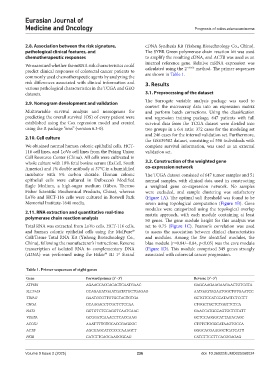
commonly used chemotherapeutic agents by analyzing the are shown in Table 1.
risk differences associated with clinical information and 3. Results
various pathological characteristics in the TCGA and GEO
datasets. 3.1. Preprocessing of the dataset
The Surrogate variable analysis package was used to
2.9. Nomogram development and validation
convert the microarray data into an expression matrix
Multivariable survival analysis and nomograms for and perform batch corrections. Using the classification
predicting the overall survival (OS) of every patient were and regression training package, 647 patients with full
established using the Cox regression model and created survival data from the TCGA dataset were divided into
using the R package “rms” (version 6.3-0). two groups in a 6:4 ratio: 372 cases for the modeling set
and 246 cases for the internal validation set. Furthermore,
2.10. Cell culture
the GSE39582 dataset, consisting of 556 individuals with
We obtained normal human colonic epithelial cells, HCT- complete survival information, was used as an external
116 cell lines, and LoVo cell lines from the Peking Union validation set.
Cell Resource Center (China). All cells were cultivated in
whole culture with 10% fetal bovine serum (ExCell, South 3.2. Construction of the weighted gene
America) and 1% double antibody at 37°C in a humidified co-expression network
incubator with 5% carbon dioxide. Human colonic The TCGA dataset consisted of 647 tumor samples and 51
epithelial cells were cultured in Dulbecco’s Modified normal samples, with clinical data used in constructing
Eagle Medium, a high-sugar medium (Gibco, Thermo a weighted gene co-expression network. No samples
Fisher Scientific Biochemical Products, China), whereas were excluded, and sample clustering was satisfactory
LoVo and HCT-116 cells were cultured in Roswell Park (Figure 1A). The optimal soft threshold was found to be
Memorial Institute-1640 media. seven using topological computation (Figure 1B). Gene
modules were categorized using the topological overlap
2.11. RNA extraction and quantitative real-time matrix approach, with each module containing at least
polymerase chain reaction analysis 50 genes. The gene module height for this analysis was
Total RNA was extracted from LoVo cells, HCT-116 cells, set to 0.75 (Figure 1C). Pearson’s correlation was used
and human colonic epithelial cells using the MolPure to assess the association between clinical characteristics
Cell/Tissue Total RNA Kit (Yisheng Biotechnology Co., and modules. Among the five identified modules, the
China), following the manufacturer’s instructions. Reverse blue module (r=0.84/−0.84, p<0.05) was the core module
transcription of isolated RNA to complementary DNA (Figure 1D). This module comprised 349 genes strongly
(cDNA) was performed using the Hifair III 1 Strand associated with colorectal cancer progression.
st
Table 1. Primer sequences of eight genes
Gene Forward primer (5’–3’) Reverse (5’–3’)
ATP8B1 AGAACCACCACACTCAATGAAC GAGCAAGAAGAAGAACTGTCGTA
SLC39A8 CCAGAGATGAATGATATGCTGAGAG AATGAGTAGAATGGCTGTGAATCC
TINAG GAATGCGTTGTGCTACTGTGA GCTGTCCATCCATAGTCTCCTT
CHGA CCAAGACCTCGCTCTCCAA CTGGCTGCTCTGGTTCTCA
NAT2 GGTGTCTCCAGGTCAATCAAC GAACCATGCCAGTGCTGTATT
VEGFA GCGGATCAAACCTCACCAAG GCTCCAGGGCATTAGACAGC
ACOX1 AAATTTTGTGCACCGAGGGC CTGTCTGGGCATAAGTGCCA
ACTB AGCGAGCATCCCCCAAAGTT GGGCACGAAGGCTCATCATT
PKIB CATCTTCAGCAAGGGCAG CATCTTCCTTCACGGAGAG
Volume 9 Issue 2 (2025) 236 doi: 10.36922/EJMO025060024

