


Page 247 - EJMO-9-2
P. 247
Eurasian Journal of
            Medicine and Oncology                                                   Prognosis of colon adenocarcinoma


            3.4. Validation of the prognostic and predictive   274 were high-risk and 282 were low-risk, according to
            accuracy of the eight-mRNA risk signature          the model set’s median risk score. Based on the KM curve,
            Out of the 246 patients, 124 were placed in the high-risk   it was observed that the high-risk group’s survival time
            group and 122 in the low-risk group based on the model   was significantly shorter than the low-risk group (p<0.05;
            set’s median risk score. The KM curve showed that the   Figure 2G). The areas under the curve for estimating the
            high-risk  group’s  survival time was  significantly shorter   probability of survival after 1, 3, and 5 years were 0.655,
            than the low-risk group (p<0.05; Figure 2D). Using this   0.609, and 0.554, respectively (Figure 2H), after employing
            risk score, the areas under the curve for estimating the   the risk score.  PKIB and  CHGA were overexpressed
            likelihood of survival at 1, 3, and 5  years were 0.682,   in high-risk patients in the external validation queue,
            0.682, and 0.782, respectively (Figure 2E). With VEGFA   whereas VEGFA, TINAG, SLC38A8, ATP8B1, and ACOX1
            overexpression in high-risk patients and  ACOX1,   were  overexpressed  in  low-risk patients  (Figure  2I).
            APT8B1, NAT2, SLC39A8, and TINAG overexpression in   In addition, the effect of the expression of these eight
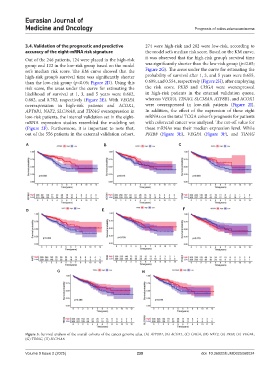
            low-risk patients, the internal validation set in the eight-  mRNAs on the total TCGA cohort’s prognosis for patients
            mRNA expression studies resembled the modeling set   with colorectal cancer was analyzed. The cut-off value for
            (Figure  2F). Furthermore, it is important to note that,   these mRNAs was their median expression level. While
            out of the 556 patients in the external validation cohort,   PKIB8  (Figure  3E),  VEGFA (Figure  3F), and  TINAG

            A                                B                               C


            D                               E                                  F


                         G                                   H


            Figure 3. Survival analysis of the overall cohorts of the cancer genome atlas. (A) ATP8B1, (B) ACOX1, (C) CHGA, (D) NAT2, (E) PKIB, (F) VEGFA,
            (G) TINAG, (H) SLC39A8.


            Volume 9 Issue 2 (2025)                        239                         doi: 10.36922/EJMO025060024

