


Page 248 - EJMO-9-2
P. 248
Eurasian Journal of
            Medicine and Oncology                                                   Prognosis of colon adenocarcinoma


            (Figure 3G) were not associated with survival outcomes,   and found that the mutation frequency of NAT2 in the
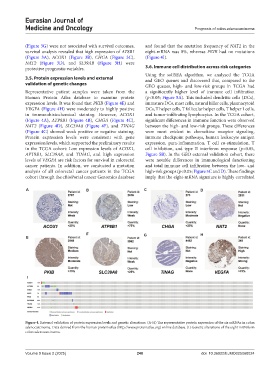
            survival analysis revealed that high expression of AT8B1   eight-mRNA was 8%, whereas  PKIB had no mutations
            (Figure  3A),  ACOX1 (Figure  3B),  CHGA (Figure  3C),   (Figure 4I).
            NAT2 (Figure  3D), and  SL39AB (Figure  3H) were
            protective prognostic variables.                   3.6. Immune cell distribution across risk categories
                                                               Using the ssGSEA algorithm, we analyzed the TCGA
            3.5. Protein expression levels and external        and GEO queues and discovered that, compared to the
            validation of genetic changes                      GEO queues, high-  and low-risk groups in TCGA had

            Representative patient samples were taken from the   a  significantly  higher  level  of  immune  cell  infiltration
            Human Protein Atlas database to examine protein    (p<0.05; Figure 5A). This included dendritic cells (DCs),
            expression levels. It was found that PKIB (Figure 4E) and   immature DCs, mast cells, natural killer cells, plasmacytoid
            VEGFA (Figure 4H) were moderately to highly positive   DCs, T helper cells, T follicular helper cells, T helper 1 cells,
            in immunohistochemical staining. However,  ACOX1   and tumor-infiltrating lymphocytes. In the TCGA cohort,
            (Figure  4A),  ATP8B1  (Figure  4B),  CHGA  (Figure  4C),   significant differences in immune function were observed
            NAT2 (Figure  4D),  SLC39A8 (Figure  4F), and  TINAG   between the high- and low-risk groups. These differences
            (Figure 4G) showed weak positive or negative staining.   were most evident in chemokine receptor signaling,
            Protein expression  levels  were consistent  with gene   immune checkpoint pathways, human leukocyte antigen
            expression levels, which supported the preliminary results   expression, para-inflammation, T cell co-stimulation, T
            in the TCGA cohort: Low expression levels of ACOX1,   cell  inhibition,  and  type  II  interferon  response  (p<0.05,
            APT8B1,  SLC39A8,  and  TINAG,  and  high  expression   Figure 5B). In the GEO external validation cohort, there
            levels of VEGFA are risk factors for survival in colorectal   were notable differences in immunological functioning
            cancer patients. In addition, we conducted a mutation   and total immune cell infiltration between the low- and
            analysis of all colorectal cancer patients in the TCGA   high-risk groups (p<0.05; Figure 5C and D). These findings
            cohort through the cBioPortal cancer Genomics database   imply that the eight-mRNA signature is highly correlated


            A                         B                       C                       D


                                      F                       G                       H
            E


            I


            Figure 4. External validation of protein expression levels and genetic alterations. (A-H) The representative protein expression of the six mRNAs in colon
            adenocarcinoma. Data derived from the human protein atlas (http://www.proteinatlas.org) online database. (I) Genetic alterations of the eight mRNAs in
            colon adenocarcinoma.


            Volume 9 Issue 2 (2025)                        240                         doi: 10.36922/EJMO025060024

