


Page 22 - ESAM-1-1
P. 22
Engineering Science in
            Additive Manufacturing                                        ML in MAM monitoring and control through images


            bodies. ML-based methods have significantly enhanced   4. Process control in MAM
            the identification of anomalies within the captured images.
                                                               As a pivotal facet of MAM automation, process control is
              For instance, Li  et al.  introduced a multi-scale   currently at the forefront of opportunities and challenges,
                                  64
            spatially interactive fusion CNN to demonstrate the   propelled by advancements in sensing technologies and
            efficacy of acoustic feature representation in reflecting   data  processing  capabilities.  Various  control  strategies,
            defect information during the LPBF process. Similarly,   such as proportional integral derivative control, sliding
            Rahman  et al.  confirmed the reliability of acoustic   mode control, predictive control, and adaptive learning
                        94
            images as a monitoring tool through the application of   control, have been employed to enable process feedback
            the K-means clustering method. Furthermore, Hossain   control in MAM. In recent years, the discourse around
            et al.  leveraged CNNs to process wavelet images for   leveraging ML algorithms for process control in MAM has
                15
            the prediction of potential defects such as cracks and   gained significant traction. With their ability to perceive,
            keyhole pores. In a different approach, Jayasinghe et al.    learn, and evolve on their own, ML techniques are well-
                                                         90
            employed an auto-regressive time-series model to analyze   positioned to be the cornerstone of intelligent control
            photodiode images in the LPBF process, successfully   systems in MAM.  These methods are instrumental in
                                                                              154
            identifying porosity within printed build layers. Acoustic   monitoring and regulating a multitude of parameters and
            and spectral images also stand out as rich reservoirs of   variables throughout the manufacturing process to achieve
            data for ML models. These images boast diverse frequency   desired outcomes.
            ranges and intricate patterns, offering insights into
            material properties. Internal defects manifest as abnormal   4.1. Melt pool control
            fluctuations within these images, thereby providing   Melt pool control stands as a critical component of MAM,
            valuable  cues  for  ML  algorithms  to detect  and  analyze   focusing  on  the  management  and  optimization  of  melt
            anomalies effectively.                             pool behavior during the printing process. Achieving the
              In the domain of  in situ monitoring for MAM, ML   required part qualities, such as surface finish, mechanical
            stands as a cornerstone. Through the application of   strength, and dimensional precision, requires careful
            ML algorithms, real-time sensor data can be effectively   control of the melt pool.
            analyzed, enabling the monitoring and regulation of the   For instance, Rezaeifar  et al.  developed a control
                                                                                          155
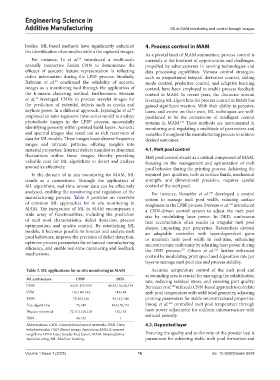
            manufacturing process.  Table  3 provides an overview   system to manage melt pool width, reducing surface
            of common ML approaches for  in situ monitoring in   roughness in the LPBF process. Devesse et al.  introduced
                                                                                                  156
            MAM. The integration of ML in MAM encompasses a    a CNN-driven control system to adjust the melt pool
            wide array of functionalities, including the prediction   size by modulating laser power. In DED, continuous
            of melt pool characteristics, defect detection, process   heat accumulation often results in irregular melt pool
            optimization, and quality control. By establishing ML   shapes, impacting part properties. Researchers devised
            models, it becomes possible to forecast and analyze melt   an adaptable controller with layer-dependent gains
            pool behaviors, improve the precision of defect detection,   to maintain melt pool width in real-time, enhancing
            optimize process parameters for enhanced manufacturing   microstructure uniformity by adjusting laser power during
            efficiency, and enable real-time monitoring and feedback   the DED process.  Gibson  et al.  further enhanced
                                                                                            158
                                                                              157
            mechanisms.                                        control by modulating print speed and deposition rate per
                                                               layer to manage melt pool size and process stability.
            Table 3. ML applications for in situ monitoring in MAM  Accurate temperature control of the melt pool and
                                                               surrounding area is crucial for managing the solidification
            ML architecture      LPBF             DED          rate, reducing residual stress, and ensuring part quality.
            CNN                64,91,133-138   49,50,126,38,139  Bernauer et al.  utilized a CNN-based approach to correlate
                                                                          159
            SVM                 116,140-142       143,144      melt pool temperature with weld bead geometry, adjusting
            KNN                 72,145,146       96,147,148    printing parameters for stable microstructural properties.
                                                                         160
            Tree algorithms      75,149          143,150,151   Smoqi et al.  controlled melt pool temperature through
            Physics-informed   72,113,126,129     152,153      laser power adjustment for uniform microstructure with
            DBN                  46,132             \          reduced porosity.
            Abbreviations: CNN: Convolutional neural networks; DBN: Deep   4.2. Deposited layer
            belief networks; DED: Direct energy deposition; KNN: K-nearest
            neighbors; LPBF: Laser powder bed fusion; MAM: Metal additive   Ensuring the quality and uniformity of the powder bed is
            manufacturing; ML: Machine learning.               paramount for achieving stable melt pool formation and


            Volume 1 Issue 1 (2025)                         16                             doi: 10.36922/esam.8548

