


Page 21 - ESAM-1-1
P. 21
Engineering Science in
            Additive Manufacturing                                        ML in MAM monitoring and control through images


            sensing  methods  for measuring  the thermal-fluid  fields   respective areas during the printing process are closely
            in the melt pool, Lu  et al.  proposed a physics-based   linked to the state of the melt pool. For instance, Repossini
                                  129
            compressive sensing algorithm to reconstruct the complete   et al.  segmented splash images within the laser heating
                                                                   130
            internal temperature and fluid fields of the melt pool based   zone during the  LPBF process, revealing an unstable
            on the surface temperature measurements captured by   melt pool alongside intense spatter spatial distribution.
            the IR camera. Besides, researchers have combined melt   In addition, Yin  et al.  discovered a strong correlation
                                                                                 131
            pool morphology and thermography data for a more   between spatter area, quantity, and laser energy density.
            comprehensive understanding of melt pool evolution.   It was also found that the formation of plumes results
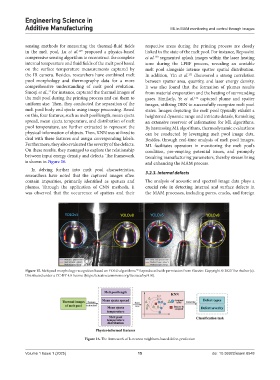
            Smoqi et al.,  for instance, captured the thermal images of   from material evaporation and the heating of surrounding
                      72
            the melt pool during the printing process and cut them to   gases. Similarly, Ye  et al.  captured plume and spatter
                                                                                    132
            uniform size. Then, they conducted the separation of the   images, utilizing DBN to successfully recognize melt pool
            melt pool body and ejecta using image processing. Based   states. Images depicting the melt pool typically exhibit a
            on this, four features, such as melt pool length, mean ejecta   heightened dynamic range and intricate details, furnishing
            spread, mean ejecta temperature, and distribution of melt   an extensive reservoir of information for ML algorithms.
            pool  temperature,  are  further  extracted  to  represent  the   By harnessing ML algorithms, thermodynamic evaluations
            physical information of objects. Then, KNN was utilized to   can be conducted by leveraging melt pool image data.
            deal with these features and assign corresponding labels.   Besides, through real-time analysis of melt pool images,
            Furthermore, they also evaluated the severity of the defects.   ML facilitates operators in monitoring the melt pool’s
            On these results, they managed to explore the relationship   condition,  pre-empting  potential  issues,  and  promptly
            between input energy density and defects. The framework   tweaking manufacturing parameters, thereby streamlining
            is shown in Figure 16.                             and enhancing the MAM process.
              In delving further into melt pool characteristics,
            researchers have noted that the captured images often   3.2.3. Internal defects
            contain impurities, primarily identified as spatters and   The analysis of acoustic and spectral image data plays a
            plumes. Through the application of CNN methods, it   crucial role  in  detecting internal and  surface  defects  in
            was observed that the occurrence of spatters and their   the MAM processes, including pores, cracks, and foreign


            Figure 15. Melt pool morphology recognition based on YOLO algorithms.  Reproduced with permission from Elsevier. Copyright © 2023 The Author(s).
                                                           50
            Distributed under a CC-BY 4.0 license (https://creativecommons.org/licenses/by/4.0/).


                                     Figure 16. The framework of k-nearest neighbors-based defect prediction


            Volume 1 Issue 1 (2025)                         15                             doi: 10.36922/esam.8548

