


Page 19 - ESAM-1-1
P. 19
Engineering Science in
            Additive Manufacturing                                        ML in MAM monitoring and control through images


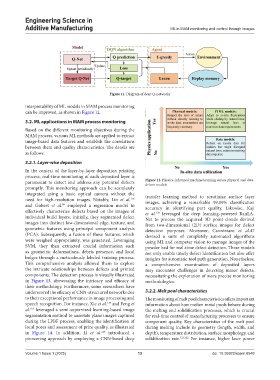
                                                Figure 11. Diagram of deep Q-networks

            interpretability of ML models in MAM process monitoring
            can be improved, as shown in Figure 12.

            3.2. ML applications in MAM process monitoring
            Based on the different monitoring objectives during the
            MAM process, various ML methods are applied to extract
            image-based data features and establish the correlations
            between them and quality characteristics. The details are
            as follows.
            3.2.1. Layer-wise deposition
            In the context of the layer-by-layer deposition printing
            process, real-time monitoring of each deposited layer is
            paramount to detect and address any potential defects   Figure 12. Physics-informed machine learning versus physical and data-
                                                               driven models
            promptly. This  monitoring approach  can be  seamlessly
            integrated  using  a  basic  optical  camera  without  the   transfer learning method to scrutinize surface layer
                                                         116
            need for high-resolution images. Notably, Lin  et al.    images, achieving a remarkable 99.89% classification
            and Gobert  et al.  employed a regression model to   accuracy in identifying part quality. Likewise, Kaji
                           99
            effectively characterize defects based on the images of   et al.  leveraged the deep learning-powered RanLA-
                                                                   120
            individual build  layers. Initially, they segmented  defect   Net to process the acquired 3D point clouds derived
            images into distinct low-dimensional edge, texture, and   from two-dimensional (2D) surface images for defect
            geometric features using principal component analysis   detection  purposes.  Moreover,  Cannizzaro  et al.47
            (PCA). Subsequently, a fusion of these features, which   devised a suite of completely automated algorithms
            were weighed appropriately, was generated. Leveraging   using ML and computer vision to manage images of the
            SVM, they then extracted crucial information such   powder bed for real-time defect detection. These models
            as geometric deformations, debris presence, and local   not only enable timely defect identification but also offer
            bulges through a meticulously labeled training process.   insights for automatic tool path generation. Nonetheless,
            This comprehensive analysis allowed them to explore   a comprehensive examination of deposited layers
            the intricate relationships between defects and printed   may encounter challenges in detecting minor defects,
            components. The detection process is visually illustrated   necessitating the exploration of more precise monitoring
            in  Figure  13, showcasing the intricacy and efficacy of   methodologies.
            their methodology. Furthermore, some researchers have
            underscored the efficacy of CNN-structured networks due   3.2.2. Melt pool characteristics
            to their exceptional performance in image processing and   The monitoring of melt pool characteristics offers important
            speech recognition. For instance, Xie et al.  and Feng et   information about how molten metal pools behave during
                                               117
            al.  leveraged a semi-supervised learning-based image   the melting and solidification processes, which is crucial
              118
            segmentation method to annotate plane images captured   for real-time control of manufacturing processes to ensure
            during the LPBF process, enabling the identification of   component  quality.  Key  characteristics  of  the  melt  pool
            local pores and assessment of print quality, as illustrated   during melting include its geometry (length, width, and
            in  Figure  14. In addition, Li  et al.  introduced a   depth), temperature distribution, surface morphology, and
                                            119
            pioneering approach by employing a CNN-based deep   solidification rate. 121,122  For instance, higher laser power

            Volume 1 Issue 1 (2025)                         13                             doi: 10.36922/esam.8548

