


Page 18 - ESAM-1-1
P. 18
Engineering Science in
            Additive Manufacturing                                        ML in MAM monitoring and control through images


            Unlike supervised learning, unsupervised learning   is deep Q-networks (DQN),  which handles high-
                                                                                        107
            identifies hidden patterns, structures, or anomalies in the   dimensional state spaces by fusing  Q-learning and deep
            data by clustering, dimensionality reduction, or generative   neural networks. In DQN, a CNN estimates the expected
            modeling. One effective unsupervised learning technique   cumulative reward for performing a particular action
            is  the  DBN,  a  hierarchical  generative  model  composed   in a particular condition, as determined by the Q-value
                                                   106
            of multiple layers of stochastic latent variables.  DBNs   function. The CNN processes raw image data (e.g., melt
            are  built using  stacked restricted  Boltzmann  machines   pool or layer images) to extract features, which are then
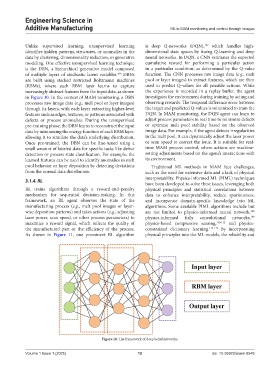
            (RBMs), where each RBM layer learns to capture     used to predict Q-values for all possible actions. While
            increasingly abstract features from the input data, as shown   the experience is recorded in a replay buffer, the agent
            in Figure 10. In the context of MAM monitoring, a DBN   investigates the environment during training by acting and
            processes raw image data (e.g., melt pool or layer images)   observing rewards. The temporal difference error between
            through its layers, with each layer extracting higher-level   the target and predicted Q-values is minimized to train the
            features such as edges, textures, or patterns associated with   DQN. In MAM monitoring, the DQN agent can learn to
            defects or process anomalies. During the unsupervised   adjust process parameters in real time to minimize defects
            pre-training phase, the DBN learns to reconstruct the input   or optimize melt pool stability based on the observed
            data by minimizing the energy function of each RBM layer,   image data. For example, if the agent detects irregularities
            allowing it to simulate the data’s underlying distribution.   in the melt pool, it can dynamically adjust the laser power
            Once pre-trained, the DBN can be fine-tuned using a   or scan speed to correct the issue. It is suitable for real-
            small amount of labeled data for specific tasks like defect   time MAM process control, where actions are machine-
            detection or process state classification. For example, the   setting adjustments based on the agent’s interactions with
            learned features can be used to identify anomalies in melt   its environment.
            pool behavior or layer deposition by detecting deviations   Traditional ML methods in MAM face challenges,
            from the normal data distribution.                 such as the need for extensive data and a lack of physical
                                                               interpretability. Physics-informed ML (PIML) techniques
            3.1.4. RL
                                                               have been developed to solve these issues, leveraging both
            RL trains algorithms through a reward-and-penalty   physical principles and statistical correlations between
            mechanism for sequential decision-making. In this   data to enhance interpretability, reduce spuriousness,
            framework, an  RL  agent  observes  the  state  of  the   and incorporate domain-specific knowledge into ML
            manufacturing process (e.g., melt pool images or layer-  algorithms. Some available PIML algorithms include but
            wise deposition patterns) and takes actions (e.g., adjusting   are not limited to physics-informed neural network,
                                                                                                            108
            laser power, scan speed, or other process parameters) to   physics-informed  fully  convolutional  networks,
                                                                                                            109
            maximize a reward signal, which reflects the quality of   physics-based compressive sensing, 110-112  and physics-
            the manufactured part or the efficiency of the process.   constrained  dictionary  learning. 113-115   By  incorporating
            As shown in  Figure  11, one prominent RL algorithm   physical principles into the ML models, the reliability and


                                            Figure 10. The framework of deep belief networks.


            Volume 1 Issue 1 (2025)                         12                             doi: 10.36922/esam.8548

