


Page 96 - ESAM-1-2
P. 96
Engineering Science in
            Additive Manufacturing                                     Impact of machine factors on PBF part surface quality


            and International  Standardization  Organization  (ISO)   a rotating hatch angle of 67°, whereas the laser beam focus
            3252:2023, with a particle size distribution of 10 – 45 μm.   diameter was 80 – 115 μm. The substrate plate was pre-
            Its mass density is 8.0 g/cm . Its chemical composition is   heated to 200°C before starting the fabrication process.
                                  3
            shown in Table 1. The powder was dried before loading   During the fabrication process, its gas flow came from
            into the PBF machine with professional dry bags (Nikon   right to left, and the recoating direction came forward and
            SLM Solutions AG, Germany) to ensure that the relative   backward (Figure 2). High-purity argon gas was pumped
            humidity of the powder was <10% before starting the PBF   into the build chamber to maintain oxygen level below
            process.                                           1,000 ppm throughout the fabrication process. Argon gas
              An AM machine was used for the PBF process (SLM280   flow speed was controlled at 22 m/s to ensure that heavy
            Twin 700W laser, Nikon SLM Solutions, Germany).    spattering and soot formed from the rapid melting process
            A powder layer thickness of 30 μm was maintained, with   could be effectively removed from the powder bed. The
                                                               oxygen level was closely monitored via the AM system’s
                                                               monitoring control system to ensure that the oxygen level
                                                               was below 1,000 ppm. The metal powder was spread onto
                                                               the substrate plate evenly with the calibrated recoater. The
                                                               gap between the recoater blade and the substrate plate was
                                                               controlled at 200 μm to ensure consistency across build
                                                               jobs. Steel substrate plates were also ground smoothly, with
                                                               their Ra <30 μm, to ensure that the building of the first
                                                               layer on the substrate plate was smooth.

                                                               2.2. Design of parts
                                                               In this study, the testing parts in Figure 3 were produced
                                                               and measured for their surface quality. Each part consisted
                                                               of a 25 × 25 × 10 mm  cube with a 25 mm diameter, 10 mm
                                                                               3
                                                               high cylinder on top. Twenty parts were produced per plate.
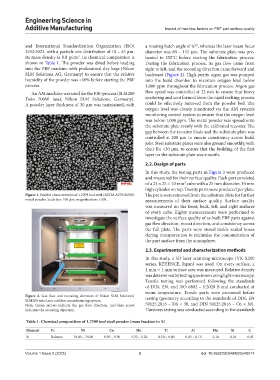
            Figure 1. Powder characteristics of 1.2709 tool steel (ASTM A276/M300)   The parts were removed from the substrate plate for further
            metal powder. Scale bar: 100 μm; magnification: ×100.  measurements of their surface quality. Surface quality
                                                               was measured on the front, back, left, and right surfaces
                                                               of every cube. Eighty measurements were performed to
                                                               investigate the surface quality of as-built PBF parts against
                                                               gas flow direction, recoat direction, and consistency across
                                                               the full plate. The parts were stored inside sealed boxes
                                                               during transportation to minimize the contamination of
                                                               the part surface from the atmosphere.

                                                               2.3. Experimental and characterization methods
                                                               In this study, a 3D laser scanning microscope (VK-X200
                                                               series, KEYENCE, Japan) was used. On every surface, a
                                                               1 mm × 1 mm surface area was measured. Relative density
                                                               was determined by testing specimens using light microscopy.
                                                               Tensile testing was performed following the standards
                                                               of DIN, EN, and ISO 6892 – 1:2020 B and conducted at
                                                               room temperature. Tensile parts were processed before
            Figure  2. Gas flow and recoating direction of Nikon SLM Solutions’   testing (geometry according to the standards of DIN, EN
            SLM280 twin laser additive manufacturing system.
            Note: Green arrows indicate the gas flow direction, and blue arrow   50125:2016 – D6 × 30, and DIN 50125:2016 – C6 × 30).
            indicates the recoating direction.                 Hardness testing was conducted according to the standards

            Table 1. Chemical composition of 1.2709 tool steel powder (mass fraction in %)
            Element    Fe          Ni           Co         Mo          Ti         Al       Mn      Si      C
            %          Balance  18.00 – 19.00  8.50 – 9.50  4.70 – 5.20  0.50 – 0.80  0.05 – 0.15  0.10  0.10  0.03


            Volume 1 Issue 2 (2025)                         3                          doi: 10.36922/ESAM025240014

