


Page 99 - ESAM-1-2
P. 99
Engineering Science in
            Additive Manufacturing                                     Impact of machine factors on PBF part surface quality


            elliptical. This would result in reduced energy density, thus   When all identical parts with the same geometry design
            causing higher Ra or even forming porosity inside the part   and the same support design were fabricated inside the
            due to a lack of fusion. Figure 8 illustrates the consequence   same build chamber, using the same argon gas settings,
            of such laser interaction due to the position of the parts.   recoating settings, metal powder, and process parameters,
            When the laser was shot directly onto the powder bed from   their  Ra varied across  the full substrate plate.  The  key
            90° vertically, the melt pool and laser spot size were nearly   factors that account for such variations are the distance
            a perfect round shape. However, when the part moved   from the parts to the gas flow outlet and the center of the
            away from the center of the laser spot, the melt pool shape   laser spot. For example, parts 1, 8, and 13 had the worst Ra
            became distorted, which negatively affected the surface   because they were furthest away from the gas flow outlet,
            quality of the as-built parts.                     as well as the center of the laser spot. On the other hand,
                                                               parts 5, 7, 11, 14, 16, 17, and 18 had better Ra because these
            3.5. Summary of the surface quality of parts
                                                               parts were placed close to either the center of the laser spot
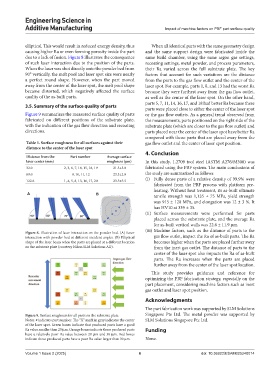
            Figure 9 summarizes the measured surface quality of parts   or the gas flow outlets. As a general trend observed from
            fabricated  on  different  positions  of  the  substrate  plate,   the measurements, parts positioned on the right side of the
            with the indication of the gas flow direction and recoating   substrate plate (which are closer to the gas flow outlet) and
            directions.                                        parts placed near the center of the laser spot have better Ra
                                                               compared with those parts that are placed away from the
            Table 5. Surface roughness for all surfaces against their   gas flow outlet and the center of laser spot position.
            distance to the center of the laser spot
                                                               4. Conclusion
            Distance from the   Part number   Average surface
            laser center (mm)                 roughness (µm)   In this study, 1.2709 tool steel (ASTM A276/M300) was
            32.0            2, 3, 6, 7, 14, 15, 18, 19  21.3±3.0  fabricated using the PBF system. The main conclusions of
            89.0                9, 10, 11, 12    23.3±2.0      the study are summarized as follows:
            122.6           1, 4, 5, 8, 13, 16, 17, 20  23.5±5.5  (i)  Fully dense parts of a relative density of 99.9% were
                                                                  fabricated from the PBF process with platform pre-
                                                                  heating. Without heat treatment, its as-built ultimate
             A                            B                       tensile strength was 1,135 ± 75 MPa, yield strength
                                                                  was 915 ± 120 MPa, and elongation was 12 ± 3 %. It
                                                                  has HV10 at 339 ± 35.
                                                               (ii)  Surface measurements were performed for parts
                                                                  placed across the substrate plate, and the average Ra
                                                                  for as-built vertical walls was 22.6 ± 11.9 μm.
                                                               (iii) Machine factors, such as the distance of parts to the
            Figure 8. Illustration of laser interaction on the powder bed. (A) Laser
            interaction with powder bed at different incident angles. (B) Elliptical   gas flow outlet, impact the Ra of as-built parts. The Ra
            shape of the laser beam when the parts are placed at a different location   becomes higher when the parts are placed further away
            on the substrate plate (courtesy Nikon SLM Solutions AG).  from the inert gas outlet. The distance of parts to the
                                                                  center of the laser spot also impacts the Ra of as-built
                                                                  parts. The Ra increases when the parts are placed
                                                                  further away from the center of the laser spot location.
                                                                 This study provides guidance and reference for
                                                               optimizing the PBF fabrication strategy, especially on the
                                                               part placement, considering machine factors such as inert
                                                               gas outlet and laser spot position.

                                                               Acknowledgments
                                                               The part fabrication work was supported by SLM Solutions
            Figure 9. Surface roughness for all parts on the substrate plate.   Singapore Pte Ltd. The metal powder was supported by
            Notes: # indicates part number. The “X” mark in gray indicates the center   SLM Solutions Singapore Pte Ltd.
            of the laser spot. Green boxes indicate that produced parts have a good
            Ra value smaller than 20 μm. Orange boxes indicate those produced parts   Funding
            have a relatively poor Ra value between 20 μm and 30 μm. Red boxes
            indicate those produced parts have a poor Ra value larger than 30 μm.  None.


            Volume 1 Issue 2 (2025)                         6                          doi: 10.36922/ESAM025240014

