


Page 58 - ESAM-1-4
P. 58
Engineering Science in
            Additive Manufacturing                                                Reusability of Ti6Al4V powder in LPBF


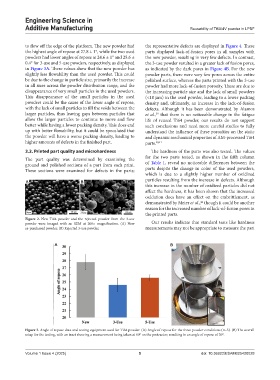
            to flow off the edge of the platform. The new powder had   the representative defects are displayed in Figure 4. These
            the highest angle of repose at 27.8 ± 1°, while the two used   parts displayed lack-of-fusion pores in all samples with
            powders had lower angles of repose at 24.6 ± 1° and 25.6 ±   the new powder, resulting in very few defects. In contrast,
            0.4° for 3-use and 5-use powders, respectively, as displayed   the 3-use powder resulted in a greater lack of fusion pores,
            in Figure 3A. These values show that the new powder has   as indicated by the dark pores in Figure 4B. For the new
            slightly less flowability than the used powder. This could   powder parts, there were very few pores across the entire
            be due to the change in particle size, primarily the increase   polished surface, whereas the parts printed with the 3-use
            in all sizes across the powder distribution range, and the   powder had more lack-of-fusion porosity. These are due to
            disappearance of very small particles in the used powders.   the increasing particle size and the lack of small powders
            This disappearance of the small particles in the used   (<10 μm) in the used powder, leading to a lower packing
            powders could be the cause of the lower angle of repose,   density and, ultimately, an increase in the lack-of-fusion
            with the lack of small particles to fill the voids between the   defects. Although it has been demonstrated by Alamos
            larger particles, thus leaving gaps between particles that   et al.,  that there is no noticeable change in the fatigue
                                                                   39
            allow  the  larger  particles  to  continue  to  move  and  flow   life  of  reused  Ti64  powder,  our  results  do  not  support
            better while having a lower packing density. This does end   such conclusions and need more careful studies to fully
            up with better flowability, but it could be speculated that   understand the influence of these porosities on the static
            the powder will have a worse packing density, leading to   and dynamic mechanical properties of AM-processed Ti64
            higher amounts of defects in the finished part.    parts. 40,41
            3.2. Printed part quality and microhardness          The hardness of the parts was also tested. The values

            The part quality was determined by examining the   for the two parts tested, as shown in the fifth column
            ground and polished sections of a part from each print.   of Table 1, reveal no noticeable differences between the
            These sections were examined for defects in the parts;   parts  despite  the  change  in  color  of  the  used  powders,
                                                               which is due to a slightly higher number of oxidized

            A                      B                           particles resulting from the increase in defects. Although
                                                               this increase in the number of oxidized particles did not
                                                               affect the hardness, it has been shown that the increased
                                                               oxidation  does  have  an  effect on  the embrittlement,  as
                                                               demonstrated by Meier et al.,  though it could be another
                                                                                      42
                                                               reason for the increased number of lack-of-fusion pores in
                                                               the printed parts.
            Figure  2.  New Ti64 powder and the rejected powder from the 3-use
            powder  were  imaged  with  an SEM  at  200×  magnification. (A)  New   Our results indicate that standard tests like hardness
            as-purchased powder. (B) Rejected 3-use powder.    measurements may not be appropriate to measure the part


                        A                                                B


            Figure 3. Angle of repose data and testing equipment used for Ti64 powder. (A) Angle of repose for the three powder conditions (n=5). (B) The overall
            setup for the testing, with an inset showing a measurement being taken at 60° on the protractor, resulting in an angle of repose of 30°.


            Volume 1 Issue 4 (2025)                         5                          doi: 10.36922/ESAM025420028

