


Page 57 - ESAM-1-4
P. 57
Engineering Science in
            Additive Manufacturing                                                Reusability of Ti6Al4V powder in LPBF


                         A                                   B


                         C                                   D


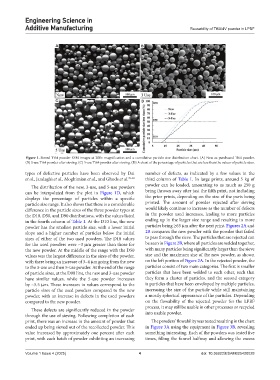
            Figure 1. Sieved Ti64 powder SEM images at 200× magnification and a cumulative particle size distribution chart. (A) New as-purchased Ti64 powder.
            (B) 3-use Ti64 powder after sieving. (C) 5-use Ti64 powder after sieving. (D) A chart of the percentage of particles that are less than the values of particle sizes.

            types  of  defective  particles have  been  observed by Dai   number  of  defects,  as indicated  by  a few  values  in  the
            et al., Jandaghi et al., Moghimian et al., and Ghods et al. 35-38  third column of Table 1. In large prints, around 5 kg of
              The distribution of the new, 3-use, and 5-use powders   powder can be loaded, amounting to as much as 250  g
            can be interpolated from the plot in  Figure  1D, which   being thrown away after just the fifth print, not including
            displays  the  percentage  of  particles  within  a  specific   the prior prints, depending on the size of the parts being
            particle size range. It also shows that there is a considerable   printed. The amount of powder rejected after sieving
            difference in the particle sizes of the three powder types at   would likely continue to increase as the number of defects
            the D10, D50, and D90 distributions, with the values listed   in the powder used increases, leading to more particles
            in the fourth column of Table 1. At the D10 line, the new   ending up in the larger size range and resulting in more
            powder has the smallest particle size, with a lower initial   particles being ≥63 μm after the next print. Figures 2A and
            slope and a higher number of particles below the initial   2B compares the new powder with the powder that failed
            sizes of either of the two used powders. The D10 values   to pass through the sieve. The particles that are rejected can
            for the used powders were ~3 μm greater than those for   be seen in Figure 2B, where all particles are welded together,
            the new powder. At the middle of the range with the D50   with many particles being significantly larger than the sieve
            values was the largest difference in the sizes of the powder,   size and the maximum size of the new powder, as shown
            with there being an increase of 3–4 μm going from the new   on the left portion of Figure 2A. In the rejected powder, the
            to the 3-use and then 5-use powder. At the end of the range   particles consist of two main categories. The first is smaller
            of particle sizes, at the D90 line, the new and 3-use powder   particles that have been welded to each other, such that
            have similar values, while the 5-use  powder increases   they form a cluster of particles, and the second category
            by ~5.5 μm. These increases in values correspond to the   is particles that have been enveloped by multiple particles,
            particle sizes of the used powders compared to the new   increasing the size of the particle while still maintaining
            powder, with an increase in defects in the used powders   a mostly spherical appearance of the particles. Depending
            compared to the new powder.                        on the flowability of the rejected powder for the LPBF
                                                               process, it may still be usable in other processes or recycled
              These defects are significantly reduced in the powder
            through the use of sieving. Following completion of each   into usable powder.
            print, there was an increase in the amount of powder that   The powders’ flowability was tested resulting in the chart
            ended up being sieved out of the recollected powder. This   in Figure 3A using the equipment in Figure 3B, revealing
            value increased by approximately one percent after each   something interesting. Each of the powders was tested five
            print, with each batch of powder exhibiting an increasing   times, filling the funnel halfway and allowing the excess


            Volume 1 Issue 4 (2025)                         4                          doi: 10.36922/ESAM025420028

