


Page 70 - GHES-1-2
P. 70
Global Health Econ Sustain                                         Stochastic modeling of age at menopausal


            considered when girls have menarche. If the average age of   2018 data. From the analysis and graphical presentation,
            menarche is considered as 15 years then the expected age   the logistic distribution was found to be a good fit so it
            of menopause is after 31.146 years of menarche.    was recommended to use this distribution, calculate the
              Another data set of Nepalese women’s age at menopause   waiting time for menopause, and describe the age pattern
            was taken from Koirala & Manandhar (2018) and the fitted   of women at menopause.
            results were compared with the results of 2005 data. Table 2   Moreover,  after  fitting  the logistic  distribution,  the
            shows the descriptive measures of the second data set.  fitted value of cumulative distribution was used to compute
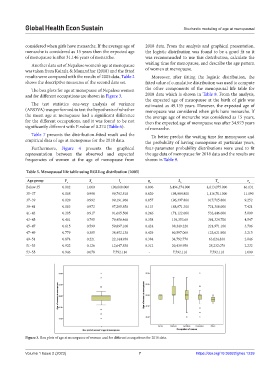
              The box plots for age at menopause of Nepalese women   the other components of the menopausal life table for
            and for different occupations are shown in Figure 3.  2018 data which is shown in Table 8. From the analysis,
                                                               the expected age of menopause at the birth of girls was
              The test statistics one-way analysis of variance   estimated as 49.135 years. However, the expected age of
            (ANOVA) was performed to test the hypothesis of whether   menopause was considered when girls have menarche. If
            the mean age at menopause had a significant difference   the average age of menarche was considered as 15 years,
            for the different occupations, and it was found to be not   then the expected age of menopause was after 34.973 years
            significantly different with P-value of 0.274 (Table 6).  of menarche.
              Table 7 presents the distribution-fitted result and the   To better predict the waiting time for menopause and
            empirical data of age at menopause for the 2018 data.  the probability of having menopause at particular years,
              Furthermore,  Figure  4  presents  the  graphical   four-parameter probability distributions were used to fit
            representation between the observed and expected   the age data of menopause for 2018 data and the results are
            frequencies of women at the age of menopause from   shown in Table 9.

            Table 5. Menopausal life table using RGLLog distribution (2005)
             Age group       F         S            l           q            L               T            e
                              x         x           x            x            x               x            x
            Below 35        0.002     1.000     100,000.000    0.006     3,496,374.000   4,613,075.000   46.131
            35–37           0.008     0.998      99,792.810    0.020      198,984.800    1,116,701.000   11.190
            37–39           0.028     0.992      99,191.960    0.057      196,397.800     917,715.800    9.252
            39–41           0.083     0.972      97,205.850    0.133      188,871.300     721,318.000    7.421
            41–43           0.205     0.917      91,665.500    0.246      171,122.000     532,446.600    5.809
            43–45           0.401     0.795      79,456.460    0.358      139,353.60      361,324.700    4.547
            45–47           0.615     0.599      59,897.100    0.424      98,349.220      221,971.100    3.706
            47–49           0.779     0.385      38,452.130    0.429      60,597.060      123,621.900    3.215
            49–51           0.874     0.221      22,144.930    0.384      34,792.770      63,024.830     2.846
            51–53           0.922     0.126      12,647.830    0.312      20,439.950      28,232.070     2.232
            53–55           0.946     0.078      7,792.116      -          7,792.116      7,792.116      1.000


            Figure 3. Box plots of age at menopause of women and for different occupations for 2018 data.


            Volume 1 Issue 2 (2023)                         7                        https://doi.org/10.36922/ghes.1239

