


Page 66 - GHES-1-2
P. 66
Global Health Econ Sustain Stochastic modeling of age at menopausal
of menopause using data from Nepalese women. Among 1
several distributions, they used the type-I extreme value Fx () = x− (2)
1
γ
model to describe the distribution of the menopausal timing − β
of Nepalese women. By observing the right skew nature of 1+ e
data, normal, Weibull, logistic, and log-logistic distributions Where γ > 0 is any arbitrary threshold parameter and
have been used in this paper to describe the distributional β > 0 represents the scale factor of the model. The mean
pattern of Nepali women. Logistic distribution was found and variance of the distribution were computed using the
to better capture the distributional pattern in this study. βπ
22
Furthermore, a new four-parameter RGLLog distribution was relation as γ and , respectively (Johnson et al., 1995).
tested for the goodness of fit. This distribution was applied 3
since it has four parameters and the result may create a more 3.2.2. Log-logistic distribution
realistic menopause prediction pattern.
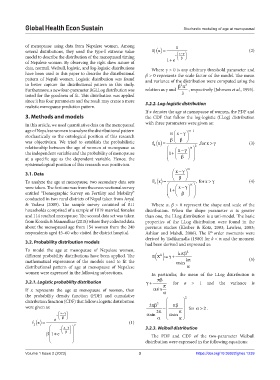
If x denotes the age at menopause of women, the PDF and
3. Methods and models the CDF that follow the log-logistic (LLog) distribution
In this article, we used quantitative data on the menopausal with three parameters were given as:
age of Nepalese women to analyze the distributional pattern α x −γ α− 1
stochastically so the ontological position of this research
was objectivism. We tried to establish the probabilistic f ( ) x = β β , for x > γ (3)
relationship between the age of women at menopause as 2 x −γ α 2
the independent variable and the probability of menopause 1+
at a specific age as the dependent variable. Hence, the β
epistemological position of this research was positivism.
x −γ α
3.1. Data β
To analyze the age at menopause, two secondary data sets F 2 ( ) x = α , for x > γ (4)
were taken. The first one was from the cross-sectional survey 1+ x −γ
entitled “Demographic Survey on Fertility and Mobility” β
conducted in two rural districts of Nepal taken from Aryal
& Yadava (2005). The sample survey consisted of 811 Where α, β > 0 represent the shape and scale of the
households comprised of a sample of 1019 married females distribution. When the shape parameter α is greater
and 114 reached menopause. The second data set was taken than one, the LLog distribution is a uni-model. The basic
from Koirala & Manandhar (2018) where they collected data properties of the LLog distribution were found in the
about the menopausal age from 154 women from the 240 previous studies (Kleiber & Kotz, 2003; Lawless, 2003;
respondents aged 45–60 who visited the district hospital. Ashkar and Mahdi, 2006). The k order moments were
th
derived by Tadikamalla (1980) for k < α and the moment
3.2. Probability distribution models had been derived and expressed as:
To model the age at menopause of Nepalese women, k
different probability distributions have been applied. The EX k k πβ
( ) = γ+
mathematical expressions of the models used to fit the α sin kπ (5)
distributional pattern of age at menopause of Nepalese α
women were expressed in the following subsections. In particular, the mean of the LLog distribution is
3.2.1. Logistic probability distribution γ + πβ π for α > 1 and the variance is
If x represents the age at menopause of women, then αsin α
the probability density function (PDF) and cumulative 2
distribution function (CDF) that follow a logistic distribution 2
were given as: 2πβ − πβ for α> 2 .
x− 2π π α
γ
− α sin sin
e β α α
fx () = (1)
1
− x− 2 3.2.3. Weibull distribution
γ
β 1+ e β
The PDF and CDF of the two-parameter Weibull
distribution were expressed in the following equations:
Volume 1 Issue 2 (2023) 3 https://doi.org/10.36922/ghes.1239

