


Page 158 - GHES-2-1
P. 158
Global Health Econ Sustain                                              Total sugar consumption Philippines


            contributed 31 – 36% of total sugar, while processed foods   sugar), followed by (in decreasing order) baked products
            (considered to have added sugar) contributed 64 – 75% of   (15%) and sugar and confectionery (11.3%). For children
            total sugar.                                       aged 1 – 2  years old, sugar and confectionery were the
                                                               highest contributor (18%), followed by milk formula and
            3.3.1. Processed foods and food products           milk products (17.9%), baked products (12.7%), and non-
            For children aged 7 – 11 months old, milk formula and milk   alcoholic beverages (10.1%). Sugar and confectionery were
            products were the largest sources of sugar (37.3% of total   the highest sugar contributors in the groups aged 3 – 8 years
                                                               old and 9 – 18 years old (20.8% and 21%, respectively). The
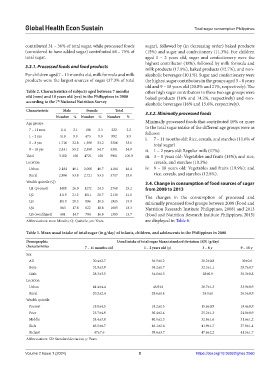
            Table 2. Characteristics of subjects aged between 7 months   other high sugar contributors in these two age groups were
            old (mos) and 18 years old (yrs) in the Philippines in 2008   baked products (18% and 14.2%, respectively) and non-
            according to the 7 National Nutrition Survey       alcoholic beverages (16% and 15.6%, respectively).
                          th
            Characteristic  Male      Female      Total        3.3.2. Minimally processed foods
                         Number  %    Number  %  Number  %
            Age groups                                         Minimally processed foods that contributed 10% or more
             7 – 11 mos    114  2.1  108   2.3  222    2.2     to the total sugar intake of the different age groups were as
                                                               follows:
             1 – 2 yrs     519  9.9  473   9.9  992    9.9     i.   7 – 11 months old: Rice, cereals, and starches (11.6% of
             3 – 8 yrs    1,716  32.8  1,590  33.2  3306  33.0    total sugar)
             9 – 18 yrs   2,831  55.2  2,550  54.7  5381  54.9  ii.  1 – 2 years old: Regular milk (17%)
            Total         5180  100  4721  100  9901  100.0    iii.  3 – 8 years old: Vegetables and fruits (14%); and rice,
            Location                                              cereals, and starches (10.3%)
             Urban        2,184  46.1  2,000  46.7  4184  46.4  iv.  9 – 18 years old: Vegetables and fruits (19.9%); and
             Rural        2,996  53.8  2,721  53.3  5717  53.6    rice, cereals, and starches (12.8%).
            Wealth quintile (Q)                                3.4. Change in consumption of food sources of sugar
             Q1 (poorest)  1488  26.0  1272  24.3  2760  25.2  from 2008 to 2013
             Q2           1119  21.2  1011  20.7  2130  21.0   The changes in the consumption of processed and
             Q3           1019  20.3  896  19.5  1915  19.9    minimally processed food groups between 2008 (Food and
             Q4            863  17.8  822  18.8  1685  18.3    Nutrition Research Institute Philippines, 2008) and 2013
             Q5 (wealthiest)  681  14.7  704  16.8  1385  15.7  (Food and Nutrition Research Institute Philippines, 2015)
            Abbreviations: mos: Months; Q: Quintile; yrs: Years.  are displayed in Table 6.

            Table 3. Mean usual intake of total sugar (in g/day) of infants, children, and adolescents in the Philippines in 2008

            Demographic                            Usual intake of total sugar Mean±standard deviation (SD) (g/day)
            characteristics          7 – 11 months old        1 – 2 years old (y)      3 – 8 y         9 – 18 y
            Sex
             All                         30.4±2.7                 36.5±1.2             30.2±0.8         30±0.6
             Boys                        32.9±3.9                 38.2±1.7             32.3±1.1        29.7±0.7
             Girls                       28.3±3.5                 34.6±1.5             28±0.9          30.3±0.8
            Location
             Urban                       41.4±4.4                 45.9±2               36.7±1.3        33.9±0.9
             Rural                       20.2±2.4                 28.6±1.4             24.9±1          26.5±0.9
            Wealth quintile
             Poorest                     18.8±4.5                 18.2±1.5             15.6±0.9        19.4±0.9
             Poor                        23.7±4.9                 30.4±2.4             25.2±1.3        24.8±0.9
             Middle                      24.4±3.8                 40.9±2.3             32.8±1.6        31.6±1.2
             Rich                        43.5±6.7                 46.1±2.6             41.9±1.7        37.8±1.4
             Richest                     47±7.6                   59.6±3.7             47.6±2.2        41.5±1.7
            Abbreviations: SD: Standard deviation; y: Years.


            Volume 2 Issue 1 (2024)                         5                        https://doi.org/10.36922/ghes.2060

