


Page 159 - GHES-2-1
P. 159
Global Health Econ Sustain                                              Total sugar consumption Philippines


                                                               4. Discussion

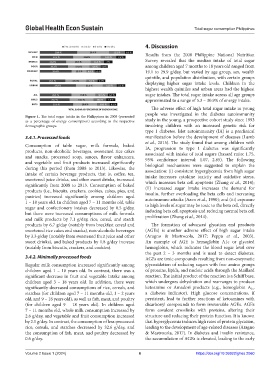
                                                               Results from the 2008 Philippine National Nutrition
                                                               Survey revealed that the median intake of total sugar
                                                               among children aged 7 months to 18 years old ranged from
                                                               19.1 to 29.9  g/day, but varied by age group, sex, wealth
                                                               quintile, and population distribution, with certain groups
                                                               displaying higher sugar intake levels. Children in the
                                                               highest wealth quintiles and urban areas had the highest
                                                               sugar intakes. The total sugar intake across all age groups
                                                               approximated to a range of 5.3 – 30.9% of energy intake.
                                                                 The adverse effect of high total sugar intake in young
                                                               people was investigated in the diabetes autoimmunity
            Figure 1. The total sugar intake in the Philippines in 2008 (presented
            as a percentage of energy consumption) according to the respective   study in the young, a prospective cohort study since 1993
            demographic groups.                                involving children with an increased genetic risk for
                                                               type  1 diabetes. Islet autoimmunity (IA) is a preclinical
            3.4.1. Processed foods                             manifestation before the development of diseases (Lamb
                                                               et al., 2015). The study found that among children with
            Consumption of  table sugar, milk formula, baked   IA, progression to type  1 diabetes was significantly
            products, non-alcoholic beverages, sweetened rice cakes   associated with intake of total sugars (hazard ratio: 1.75,
            and snacks, processed soup, sauces, flavor enhancers,   95%  confidence  interval:  1.07,  2.85).  The following
            and  vegetable  and  fruit  products increased significantly   biological mechanisms were suggested to explain the
            during this period (from 2008 to 2013). Likewise, the   association: (i) consistent hyperglycemia from high sugar
            intake of certain beverage products, that is, coffee, tea,   intake increases cytokine toxicity and oxidative stress,
            sweetened juice drinks, and other sweet drinks, increased   which increases beta cell apoptosis (Zhang  et al., 2014);
            significantly from 2008 to 2013. Consumption of baked   (ii) increased sugar intake increases the demand for
            products (i.e., biscuits, crackers, cookies, cakes, pies, and   insulin, further overloading the beta cells and increasing
            pastries) increased significantly among children aged   autoimmune attacks (Aaen et al., 1990); and (iii) exposure
            1 – 18 years old. In children aged 7 – 11 months old, table   to high levels of sugar may be toxic to the beta cell, directly
            sugar and confectionery intakes decreased by 0.5  g/day,   inducing beta cell apoptosis and reducing normal beta cell
            but there were increased consumptions of milk formula
            and milk products by 7.1  g/day, rice, cereal, and starch   proliferation (Zhang et al., 2014).
            products by 6.7 g/day (notably from breakfast cereal and   The formation of advanced glycation end products
            sweetened rice cakes and snacks), non-alcoholic beverages   (AGEs) is another adverse effect of high sugar intake
            by 3.3 g/day (notably from sweetened fruit juice and other   (Aragno & Mastrocola, 2017; Peppa  et al., 2003).
            sweet drinks), and baked products by 1.8 g/day increase   An example of AGE is hemoglobin A1c or glycated
            (notably from biscuits, crackers, and cookies).    hemoglobin, which indicates the blood sugar level over
                                                               the past 2 – 3  months and is used to detect diabetes.
            3.4.2. Minimally processed foods                   AGEs are toxic compounds resulting from non-enzymatic

            Regular milk consumption increased significantly among   glycoxidation of reducing sugars with free amino groups
            children aged 1 – 18  years old. In contrast, there was a   of proteins, lipids, and nucleic acids through the Maillard
            significant decrease in fruit and vegetable intake among   reaction. The initial product of the reaction is a Schiff base,
            children  aged 3  –  18  years  old.  In addition,  there  were   which undergoes dehydration and rearranges to produce
            significantly decreased consumptions of rice, cereals, and   ketoamine  or  Amadori  products  (e.g.,  hemoglobin  A 1c,
            starches (for children aged 7 – 11 months old, 1 – 2 years   a diabetes indicator). High glucose concentrations, if
            old, and 9 – 18 years old), as well as fish, meat, and poultry   persistent,  lead  to  further  reactions  of  ketoamines  with
            (for children aged 9 – 18  years old). In children aged   dicarbonyl compounds to form irreversible AGEs. AGEs
            7 – 11 months old, whole milk consumption increased by   form covalent crosslinks with proteins, altering their
            2.6 g/day, and vegetable and fruit consumption increased   structure and reducing their protein function. It is known
            by 2.1 g/day. In contrast, the consumption of less-processed   that hyperglycemia induces high rates of protein glycation,
            rice, cereals, and starches decreased by 32.6  g/day, and   leading to the development of age-related diseases (Aragno
            the consumption of fish, meat, and poultry decreased by   & Mastrocola, 2017). In diabetes and insulin resistance,
            0.6 g/day.                                         the accumulation of AGEs is elevated, leading to the early


            Volume 2 Issue 1 (2024)                         6                        https://doi.org/10.36922/ghes.2060

