


Page 106 - GHES-3-2
P. 106
Global Health Economics and
            Sustainability
                                                                        Association of teleworking with employee well-being


            were women. As for their marital status, 52.4% were single,   Finally, the sample was asked about several items
            17.5% were married, 5.8% were divorced, and 24.3% were   related to employee well-being. First, they were asked
            in a relationship. Regarding children in the family, 76.7%   about their perceptions of work-life balance during
            stated that they did not have children, while10% had one   teleworking. The largest segment (80%) answered that
            child, 10% had two children, and 4% had three or more   “I have a good balance, but there is always room for
            children. Based on the educational level of the sample,   improvement.” They were also asked if the overall well-
            21.4% were high school graduates, 27.2% were college   being of workers has changed because of the work,
            graduates, and 51.5% had postgraduate degrees. Regarding   after which the largest segment (65%) answered that it
            their fields of work, the largest segment (49.5%) selected   “Depends on the circumstances.” This indicates that there
            “another industry,” while17.4%workedin the financial and   is no consensus among the employees. Finally, the sample
            insurance  sector,  12%  worked  in  telecommunications,   was  asked  about  how  they  perceived  social  cohesion
            information technologies, and other information    in relation to the workplace. In this case, the majority
            services, 10% worked in marketing, and 10% worked   (61%) responded that “Social cohesion in the workplace
            in pharmaceutical and parapharmaceutical  products.   is satisfactory, but could be improved with more social
            As for the number of employees, 10% worked in      activities.”
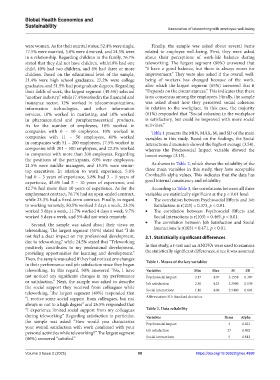
            companies  with 0 – 10 employees, 10% worked in      Table 1 presents the MIN, MAX, M, and SD of the main
            companies with 11  –  50 employees, 41%  worked    variables in this study. Based on the findings, the Social
            in companies with 51 – 200 employees, 17.5% worked in   Interactions dimension showed the highest average (3.54),
            companies with 201 – 500 employees, and 22.3% worked   whereas the Psychosocial Impact variable showed the
            in companies with more than 200 employees. Regarding   lowest average (3.15).
            the  positions  of  the  participants,  63%  were  employees,
            21.5% were middle managers, and 15.5% were senior-   As shown in Table 2, which shows the reliability of the
            top executives. In relation to work experience, 5.8%   three main variables in this study, they have acceptable
            had 0 – 3  years of experience, 5.8% had 3 – 5  years of   Cronbach’s alpha values. This indicates that the data has
            experience, 45.6% had 5 – 10  years of experience, and   good internal consistency and reliability.
            42.7% had more than 10 years of experience. As for the   According to Table 3, the correlations between all three
            employment contract, 76.7% had an open-ended contract,   variables are statistically significant at the p < 0.01 level:
            while 23.3% had a fixed-term contract. Finally, in regard   •   The correlation between Psychosocial Effects and Job
            to working remotely, 50.5% worked 2 days a week, 23.3%   Satisfaction is r(103) = 0.373, p < 0.01.
            worked 3 days a week, 11.7% worked 4 days a week, 9.7%   •   The correlation between Psychosocial Effects and
            worked 5 days a week, and 5% did not work remotely.   Social Interactions is r(103) = 0.469, p < 0.01.
              Second, the sample was asked about their views on   •   The  correlation  between  Job Satisfaction  and Social
            teleworking. The largest segment (51%) stated that “I do   Interactions is r(103) = 0.471, p < 0.01.
            not feel a clear impact on my professional development,   3.1. Statistically significant differences
            due to teleworking,” while 24.5% stated that “Teleworking
            positively contributes to my professional development,   In this study, a t-test and an ANOVA were used to examine
            providing opportunities for learning and development.”   the statistically significant differences, since it was assumed
            Then, the sample was asked if they had noticed any changes   Table 1. Means of the key variables
            in their performance and job satisfaction since they began
            teleworking. In this regard, 50% answered “No, I have   Variables       Min    Max     M     SD
            not noticed any significant changes in my performance   Psychosocial impact  2.17  4.07  3.1558  0.387
            or satisfaction.” Next, the sample was asked to describe   Job satisfaction  2.50  4.25  3.2980  0.539
            the social support they received from colleagues while   Social interactions  1.40  4.00  3.5480  0.604
            teleworking. The largest segment (49%) responded that
            “I receive some social support from colleagues, but not   Abbreviation: SD: Standard deviation.
            always or not to a high degree” and 26.5% responded that
            “I experience limited social support from my colleagues   Table 2. Data reliability
            during teleworking.” Regarding satisfaction in particular,   Variables               Items  Alpha
            the  sample  was  asked  “How  would  you  characterize   Psychosocial impact         4     0.623
            your overall satisfaction with work combined with your
            personal activities while teleworking?” The largest segment   Job satisfaction        27    0.892
            (80%) answered “satisfied.”                        Social interactions                5     0.812


            Volume 3 Issue 2 (2025)                         98                       https://doi.org/10.36922/ghes.4998

