


Page 108 - GHES-3-2
P. 108
Global Health Economics and
            Sustainability
                                                                        Association of teleworking with employee well-being


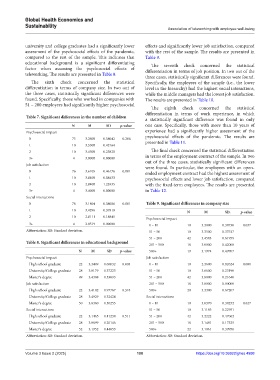
            university and college graduates had a significantly lower   effects and significantly lower job satisfaction, compared
            assessment of the psychosocial effects of the pandemic,   with the rest of the sample. The results are presented in
            compared to the rest of the sample. This indicates that   Table 9.
            educational background is a significant differentiating   The seventh check concerned the statistical
            factor when assessing the psychosocial effects of   differentiation in terms of job position. In two out of the
            teleworking. The results are presented in Table 8.
                                                               three cases, statistically significant differences were found.
              The   sixth  check  concerned  the   statistical  Specifically,  the employees  of the  sample  (i.e.,  the lower
            differentiation in terms of company size. In two out of   level in the hierarchy) had the highest social interactions,
            the three cases, statistically significant differences were   while the middle managers had the lowest job satisfaction.
            found. Specifically, those who worked in companies with   The results are presented in Table 10.
            51 – 200 employees had significantly higher psychosocial
                                                                 The   eighth  check  concerned  the  statistical
                                                               differentiation in terms of work experience, in which
            Table 7. Significant differences in the number of children
                                                               a statistically significant difference was found in only
                                N     M       SD    p-value    one case. Specifically, those with more than 10  years of
            Psychosocial impact                                experience had a significantly higher assessment of the
             0                  75   3.2600  0.58042  0.206    psychosocial effects of the pandemic. The results are
             1                  10   3.5500  0.42164           presented in Table 11.
             2                  10   3.4500  0.25820             The final check concerned the statistical differentiation
             3+                 4    3.0000  0.00000           in terms of the employment contract of the sample. In two
            Job satisfaction                                   out of the three cases, statistically significant differences
                                                               were found. In particular, the employees with an open-
             0                  76   3.6105  0.46176  0.001    ended employment contract had the highest assessment of
             1                  10   3.8400  0.08433           psychosocial effects and lower job satisfaction, compared
             2                  10   2.8400  1.23935           with the fixed-term employees. The results are presented
             3+                 4    3.4000  0.00000           in Table 12.
            Social interactions
             0                  78   3.1804  0.38086  0.001    Table 9. Significant differences in company size
             1                  10   3.4296  0.37819                             N      M        SD.   p-value
             2                  10   2.8111  0.18841           Psychosocial impact
             3+                 4    2.8519  0.00000            0 – 10           10    3.3000   0.38730  0.037
            Abbreviation: SD: Standard deviation.               11 – 50          10    3.3500   0.33747
                                                                51 – 200         42    3.4583   0.61959
            Table 8. Significant differences in educational background
                                                                201 – 500        18    3.0000   0.42008
                                   N    M      SD   p-value     500+             19    3.1974   0.49707
            Psychosocial impact                                Job satisfaction
             High school graduate  22  3.3409  0.60032  0.003   0 – 10           10    2.3600   0.82624  0.001
             University/College graduate  28  3.0179  0.37223   11 – 50          10    3.6600   0.23190
             Master’s degree       49  3.4388  0.53893          51 – 200         42    3.8000   0.21640
            Job satisfaction                                    201 – 500        18    3.8000   0.00000
             High school graduate  22  3.4182  0.97767  0.318   500+             20    3.3300   0.67207
             University/College graduate  28  3.4929  0.32424  Social interactions
             Master’s degree       50  3.6360  0.50255          0 – 10           10    3.0370   0.38252  0.627
            Social interactions                                 11 – 50          10    3.1185   0.22951
             High school graduate  22  3.1465  0.41234  0.511   51 – 200         42    3.2222   0.47062
             University/College graduate  28  3.0899  0.20146   201 – 500        18    3.1481   0.17325
             Master’s degree       52  3.1952  0.44853          500+             22    3.1061   0.39956
            Abbreviation: SD: Standard deviation.              Abbreviation: SD: Standard deviation.


            Volume 3 Issue 2 (2025)                        100                       https://doi.org/10.36922/ghes.4998

