


Page 107 - GHES-3-2
P. 107
Global Health Economics and
            Sustainability
                                                                        Association of teleworking with employee well-being


            that we have normal distributions in the main variables and   interactions, compared to the rest of the sample. The results
            do not need to conduct non-parametric tests. The first check   are presented in Table 7.
            concerned statistical differentiation by gender. In two out   The fifth check concerned the statistical differentiation
            of the three cases, statistically significant differences were   in terms of educational level. In one of the three cases, a
            found. Specifically, the women had higher psychosocial   statistically significant difference was found. Specifically,
            effects and a greater need for social interactions, compared
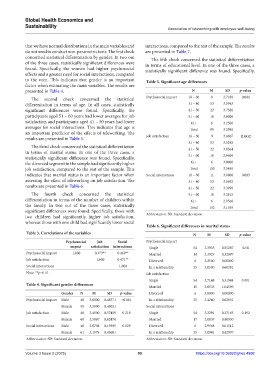
            to  the  men.  This  indicates  that  gender  is  an  important   Table 5. Significant age differences
            factor when estimating the main variables. The results are
            presented in Table 4.                                                  N      Μ      SD    p-value

              The   second  check  concerned  the  statistical  Psychosocial impact  18 – 30  8  2.7188  0.001
            differentiation in terms of age. In all cases, statistically         31 – 40  53    3.0943
            significant differences were found. Specifically, the                41 – 50  22    3.7386
            participants aged 51 – 60 years had lower averages for job           51 – 60  10    3.9000
            satisfaction and participants aged 41 – 50 years had lower            61+      6    3.2500
            averages for social interactions. This indicates that age is          Total   99    3.2980
            an important predictor of the effects of teleworking. The
            results are presented in Table 5.                  Job satisfaction  18 – 30   9    3.4667  0.002
                                                                                 31 – 40  53    3.5245
              The third check concerned the statistical differentiation          41 – 50  22    3.8364
            in terms of marital status. In one of the three cases, a
            statistically significant difference was found. Specifically,        51 – 60  10    2.9600
            the divorced segment in the sample had significantly higher           61+      6    3.8000
            job satisfaction, compared to the rest of the sample. This            Total   100   3.5480
            indicates that marital status is an important factor when   Social interactions  18 – 30  11  3.0808  0.005
            assessing the effect of teleworking on job satisfaction. The         31 – 40  53    3.0692
            results are presented in Table 6.                                    41 – 50  22    3.3990
              The   fourth  check  concerned  the  statistical                   51 – 60  10    3.2815
            differentiation in terms of the number of children within             61+      6    2.9568
            the family. In two out of the three cases, statistically              Total   102   3.1558
            significant differences were found. Specifically, those with
            two children had significantly higher job satisfaction,   Abbreviation: SD: Standard deviation.
            whereas those with one child had significantly lower social
                                                               Table 6. Significant differences in marital status
            Table 3. Correlations of the variables                                 N     M       SD    p-value

                             Psychosocial   Job    Social      Psychosocial impact
                               impact   satisfaction  interactions  Single         54   3.3935  0.55287  0.56
            Psychosocial impact  1.000   0.373**   0.469**      Married            14   3.3929  0.32097
            Job satisfaction              1.000    0.471**      Divorced            6   3.2500  0.00000
            Social interactions                     1.000       In a relationship  25   3.0500  0.60381
            Note: **p<0.01.                                    Job satisfaction
                                                                Single             54   3.7148  0.31944  0.001
            Table 4. Significant gender differences             Married            15   3.0533  1.04599
                           Gender  N    Μ      SD   p-value     Divorced            6   3.8000  0.00000
            Psychosocial impact  Male  40  3.0000  0.48371  <0.001  In a relationship  25  3.4240  0.62801
                           Female  59  3.5000  0.48021         Social interactions
            Job satisfaction  Male  40  3.4900  0.57459  0.218  Single             54   3.2291  0.37163  0.192
                           Female  60  3.5867  0.62476          Married            17   3.0839  0.40930
            Social interactions  Male  40  3.0704  0.19595  0.029  Divorced         6   2.9568  0.01512
                           Female  61  3.1979  0.45681          In a relationship  25   3.0941  0.42907
            Abbreviation: SD: Standard deviation.              Abbreviation: SD: Standard deviation.


            Volume 3 Issue 2 (2025)                         99                       https://doi.org/10.36922/ghes.4998

