


Page 109 - GHES-3-2
P. 109
Global Health Economics and
            Sustainability
                                                                        Association of teleworking with employee well-being


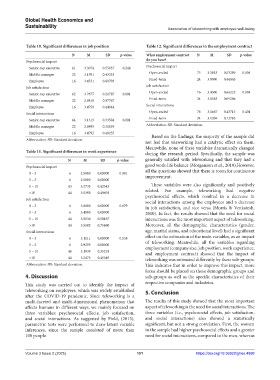
            Table 10. Significant differences in job position  Table 12. Significant differences in the employment contract
                                N     M       SD    p-value    What employment contract   N  M   SD    p-value
            Psychosocial impact                                do you have?
             Senior-top executive  61  3.3074  0.55037  0.248  Psychosocial impact
             Middle manager     22   3.1591  0.43333            Open-ended           75  3.3933  0.53299  0.001
             Employee           16   3.4531  0.60703            Fixed-term           24  3.0000  0.44843
            Job satisfaction                                   Job satisfaction
             Senior-top executive  62  3.7677  0.21787  0.001   Open-ended           76  3.4500  0.66222  0.001
             Middle manager     22   2.9818  0.97767            Fixed-term           24  3.8583  0.09286
             Employee           16   3.4750  0.44944           Social interactions
            Social interactions                                 Open-ended           78  3.1667  0.43715  0.401
             Senior-top executive  64  3.1319  0.33504  0.001   Fixed-term           24  3.1204  0.12795
             Middle manager     22   2.9899  0.31659           Abbreviation: SD: Standard deviation.
             Employee           16   3.4792  0.49255
            Abbreviation: SD: Standard deviation.                Based on the findings, the majority of the sample did
                                                               not feel that teleworking had a catalytic effect on them.
                                                               Meanwhile, none of these variables dramatically changed
            Table 11. Significant differences in work experience  during  the  research  period.  Specifically,  the  sample  was
                              N      M      SD     p-value     generally satisfied with teleworking and that they had a
            Psychosocial impact                                good work-life balance (Morganson et al., 2010).However,
                                                               all the questions showed that there is room for continuous
             0 – 3            6    2.5000  0.00000  0.001      improvement.
             3 – 5            6    2.5000  0.00000
             5 – 10           43   3.2733  0.42543               These  variables  were  also significantly  and positively
             >10              44   3.5398  0.49692             related. For example, teleworking had negative
            Job satisfaction                                   psychosocial effects, which resulted in a decrease in
                                                               social interactions among the employees and a decrease
             0 – 3            6    3.8000  0.00000  0.679      in job satisfaction, and vice versa (Morris & Venkatesh,
             3 – 5            6    3.4000  0.00000             2010). In fact, the results showed that the need for social
             5 – 10           44   3.5636  0.50167             interactions was the most important aspect of teleworking.
             >10              44   3.5182  0.75860             Moreover,  all  the  demographic  characteristics  (gender,
            Social interactions                                age, marital status, and educational level) had a significant
             0 – 3            6    3.1111  0.00000  0.138      effect on the estimation of the main variables, as an impact
             3 – 5            6    2.9259  0.00000             of teleworking. Meanwhile, all the variables regarding
                                                               employment (company size, job position, work experience,
             5 – 10           46   3.1039  0.35218             and employment contract) showed that the impact of
             >10              44   3.2475  0.45049             teleworking was estimated differently by these sub-groups.
            Abbreviation: SD: Standard deviation.              This indicates that in order to improve this impact, more
                                                               focus should be placed on these demographic groups and
            4. Discussion                                      sub-groups as well as the specific characteristics of their

            This study was carried out to identify the impact of   respective companies and industries.
            teleworking on employees, which was widely established   5. Conclusion
            after the COVID-19 pandemic. Since teleworking is a
            multi-faceted and multi-dimensional phenomenon that   The results of this study showed that the most important
            affects humans in different ways, we mainly focused on   aspect of teleworking is the need for social interactions. The
            three variables: psychosocial effects, job satisfaction,   three variables (i.e., psychosocial effects, job satisfaction,
            and social interactions. As suggested by Field, (2013),   and social interactions) also showed a statistically
            parametric tests were performed to draw latent variable   significant, but not a strong correlation. First, the women
            inferences, since the sample consisted of more than   in the sample had higher psychosocial effects and a greater
            100 people.                                        need for social interactions, compared to the men, whereas


            Volume 3 Issue 2 (2025)                        101                       https://doi.org/10.36922/ghes.4998

