


Page 75 - GHES-3-2
P. 75
Global Health Economics and
            Sustainability
                                                                                      Climate change and quality of life


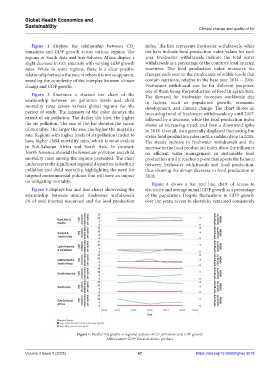
              Figure  1 displays the relationship between CO    index. The line represents freshwater withdrawals, while
                                                          2
            emissions and GDP growth across various regions. The   the bars indicate food production index values for each
            regions of South Asia and Sub-Saharan Africa display a   year. Freshwater withdrawals indicate the total water
            slight decrease in CO  intensity with varying GDP growth   withdrawals as a percentage of the country’s total internal
                             2
            rates. While in some regions, there is a clear positive   resources. The food production index measures the
            relationship between the two; in others it is not so apparent,   changes each year in the production of edible foods that
            revealing the complexity of the interplay between climate   contain nutrients, relative to the base year 2014 – 2016.
            change and GDP growth.                             Freshwater withdrawal can be for different purposes,
                                                               one of them being the production of food in agriculture.
              Figure  2 illustrates a stacked bar chart of the   The demand for freshwater increases worldwide due
            relationship between air pollution levels and child   to factors, such as population growth, economic
            mortality  rates  across  various  global  regions  for  the   development, and climate change. The chart shows an
            period of study. The intensity of the color denotes the   increasing trend of freshwater withdrawals up until 2017,
            extent of air pollution. The darker the blue, the higher   followed by a decrease, while the food production index
            the air pollution. The size of the bar denotes the extent   shows an increasing trend, and then a downward spike
            of mortality. The larger the size, the higher the mortality   in 2018. Overall, data generally displayed fluctuating but
            rate. Regions with higher levels of air pollution tended to   stable food production rates until a sudden drop in 2018.
            have higher child mortality rates, which is most evident   The  steady  increase  in  freshwater  withdrawals  and  the
            in  Sub-Saharan  Africa  and  South  Asia.  In  contrast,   increase in the food production index show the influence
            North America showed the lowest air pollution and child   on efficient water management in sustainable food
            mortality rates among the regions presented. The chart   production until it reaches a point that upsets the balance
            underscores the significant regional disparities in both air   between freshwater withdrawals and food production,
            pollution and child mortality, highlighting the need for   thus showing the abrupt decrease in food production in
            targeted environmental policies that will have an impact   2018.
            on mitigating mortality.                             Figure  4 shows a bar and line chart of access to

              Figure 3 displays bar and line charts showcasing the   electricity and average annual GDP growth as a percentage
            relationship between annual freshwater withdrawals   of the population. Despite fluctuations in GDP growth
            (% of total internal resources) and the food production   over the years, access to electricity remained consistently


                                  Figure 1. Parallel line graphs of regional analysis of CO  emissions and GDP growth
                                                                     2
                                              Abbreviation: GDP: Gross domestic product.

            Volume 3 Issue 2 (2025)                         67                       https://doi.org/10.36922/ghes.5018

