


Page 80 - GHES-3-2
P. 80
Global Health Economics and
            Sustainability
                                                                                      Climate change and quality of life


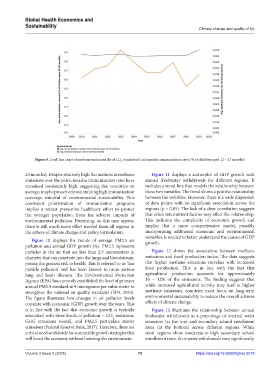
                Figure 9. Dual-line chart of methane emissions (kt of CO  equivalent) and measles immunization rates (% of children aged 12 – 23 months)
                                                     2

            23 months). Despite relatively high fluctuations in methane   Figure  11 displays a scatterplot of GDP growth with
            emissions over the years, measles immunization rates have   annual freshwater withdrawals for different regions. It
            remained consistently high, suggesting that countries on   includes a trend line that models the relationship between
            average, may be proactively maintaining high immunization   these two variables. The trend shows a positive relationship
            coverage,  mindful  of  environmental  sustainability.  This   between the variables. However, there is a wide dispersion
            consistent prioritization of immunization programs   of data points with no significant association across the
            implies  a  robust  preventive  healthcare  effort  to  protect   regions (p > 0.05). The lack of a clear correlation suggests
            the younger population from the adverse impacts of   that other intermittent factors may affect the relationship.
            environmental pollution. Promising, as this may appear,   This  indicates  the  complexity  of  economic  growth  and
            there is still much more effort needed from all regions in   implies that a more comprehensive model, possibly
            the sphere of climate change and policy formulation.  incorporating additional economic and environmental
                                                               variables, is needed to better understand the causes of GDP
              Figure  10 displays the trends of average PM2.5 air   growth.
            pollution and annual GDP growth (%). PM2.5 represents
            particles in the air that are less than 2.5 micrometers in   Figure  12 shows the association between methane
            diameter that can penetrate into the lungs and bloodstream,   emissions and food production index. The data suggests
            posing the greatest risk to health. This is referred to as ‘fine   that higher methane emissions correlate with increased
            particle pollution’ and has been known to cause serious   food production. This is in line with the fact that
            lung and heart diseases. The Environmental Protection   agricultural production accounts for approximately
            Agency (EPA) has currently established the level of primary   10 – 12% of the emissions. The finding suggests that
            annual PM2.5 standard at 9 micrograms per cubic meter to   while increased agricultural activity may lead to higher
            strengthen the national air quality standards (EPA, 2024).   methane emissions, countries must focus on long-term
            The figure illustrates how changes in air pollution levels   environmental sustainability to reduce the overall adverse
            correlate with economic (GDP) growth over the years. This   effects of climate change.
            is in line with the fact that economic growth is typically   Figure  13 illustrates the relationship between annual
            associated with three kinds of pollution – CO  emissions,   freshwater withdrawals as a percentage of internal water
                                                 2
            GHG  emissions overall,  and  PM2.5  particulate matter   resources (at the top) and secondary school enrollment
            emissions (Federal Reserve Bank, 2017). Therefore, there is a   rates  (at  the  bottom)  across  different  regions.  While
            critical need worldwide for sustainable growth strategies that   most regions show moderate-to-high secondary school
            will boost the economy without harming the environment.  enrollment rates, their water withdrawals vary significantly,


            Volume 3 Issue 2 (2025)                         72                       https://doi.org/10.36922/ghes.5018

