


Page 78 - GHES-3-2
P. 78
Global Health Economics and
            Sustainability
                                                                                      Climate change and quality of life


            low unemployment rate (3.947%), suggesting a strong and   production index, by visualizing the overlap and trends
            diverse economy that keeps unemployment low despite   of both variables over the years. Inflation, the consumer
            significant emissions. Middle East & North Africa presents   price (annual %),  is the % of change in the price of a
            a contrasting scenario. Although methane emissions are   basket of goods and services consumed by households. It
            the lowest among the regions, unemployment is the highest   is referred to as the consumer price index and is a well-
            (10.537%). This discrepancy highlights economic over-  known indicator of inflation. The food production index
            reliance on specific sectors and the lack of diversification. In   measures the changes each year in the production of
            summary, contrary to the expectation that unemployment   edible food, relative to the base year 2014 – 2016. While
            rates increase with methane emissions, there appears to   the consumer price index relates to food consumption, the
            be no direct correlation between methane emissions and   food production index relates to food production. Based on
            unemployment rates; regions with higher emissions do not   the figure, in 2011, where there is a spike in the inflation of
            consistently have higher unemployment rates. However,   consumer prices, there is a decrease in the food production
            there is potential for national policies that should target   index, which can be due to the result of the pressure from
            unemployment along with sustainability goals.      inflation. A drop in inflation leading to a decline in food
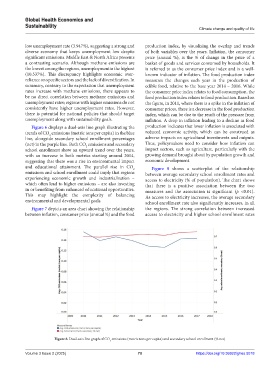
              Figure 6 displays a dual-axis line graph illustrating the   production indicates that lower inflation is associated with
            trends of CO  emissions (metric tons per capita) in the blue   reduced economic activity, which can be construed as
                      2
            line,  alongside  secondary  school  enrollment  percentages   adverse impacts on agricultural investments and outputs.
            (net) in the purple line. Both CO  emissions and secondary   Thus, policymakers need to consider how inflation can
                                      2
            school enrollment show an upward trend over the years,   impact sectors, such as agriculture, particularly with the
            with  an increase  in both  metrics  starting  around  2014,   growing demand brought about by population growth and
            suggesting that there was a rise in environmental impact   economic development.
            and educational attainment. The parallel rise in CO    Figure  8 shows a scatterplot of the relationship
                                                          2
            emissions and school enrollment could imply that regions   between average secondary school enrollment rates and
            experiencing economic growth and industrialization –   access to electricity (% of population). The chart shows
            which often lead to higher emissions – are also investing   that  there is  a  positive  association between the  two
            in or benefiting from enhanced educational opportunities.   measures and the association is significant (p <0.01).
            This may highlight the complexity of balancing     As access to electricity increases, the average secondary
            environmental and developmental goals.             school enrollment rate also significantly increases, in all

              Figure 7 depicts an area chart showing the relationship   the regions. The strong correlation between increased
            between inflation, consumer price (annual %) and the food   access to electricity and higher school enrollment rates


                        Figure 6. Dual-axis line graph of CO  emissions (metric tons per capita) and secondary school enrollment (% net)
                                                2

            Volume 3 Issue 2 (2025)                         70                       https://doi.org/10.36922/ghes.5018

