


Page 81 - GHES-3-2
P. 81
Global Health Economics and
            Sustainability
                                                                                      Climate change and quality of life


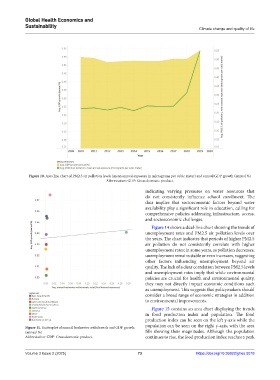
             Figure 10. Area line chart of PM2.5 air pollution levels (mean annual exposure in micrograms per cubic meter) and annual GDP growth (annual %)
                                              Abbreviation: GDP: Gross domestic product.

                                                               indicating varying pressures on  water  resources  that
                                                               do not consistently influence school enrollment. The
                                                               data implies that socioeconomic factors beyond water
                                                               availability play a significant role in education, calling for
                                                               comprehensive policies addressing infrastructure, access,
                                                               and socioeconomic challenges.
                                                                 Figure 14 shows a dual-line chart showing the trends of
                                                               unemployment rates and PM2.5 air pollution levels over
                                                               the years. The chart indicates that periods of higher PM2.5
                                                               air pollution do not consistently correlate with higher
                                                               unemployment rates; in some years, as pollution decreases,
                                                               unemployment remains stable or even increases, suggesting
                                                               other factors influencing unemployment beyond air
                                                               quality. The lack of a clear correlation between PM2.5 levels
                                                               and unemployment rates imply that while environmental
                                                               policies are crucial for health and environmental quality,
                                                               they may not directly impact economic conditions such
                                                               as unemployment. This suggests that policymakers should
                                                               consider a broad range of economic strategies in addition
                                                               to environmental improvements.
                                                                 Figure 15 contains an area chart displaying the trends
                                                               in food production index and population. The food
                                                               production index can be seen on the left y-axis while the
                                                               population can be seen on the right y-axis, with the area
            Figure 11. Scatterplot of annual freshwater withdrawals and GDP growth
            (annual %)                                         fills showing their magnitudes. Although the population
            Abbreviation: GDP: Gross domestic product.         continues to rise, the food production index reaches a peak


            Volume 3 Issue 2 (2025)                         73                       https://doi.org/10.36922/ghes.5018

