


Page 84 - GHES-3-2
P. 84
Global Health Economics and
            Sustainability
                                                                                      Climate change and quality of life


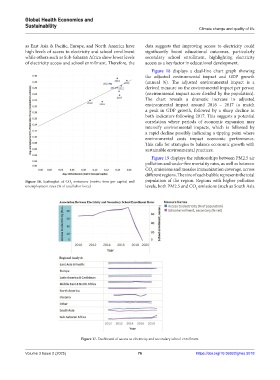
            as East Asia & Pacific, Europe, and North America have   data suggests that improving access to electricity could
            high levels of access to electricity and school enrollment   significantly boost educational outcomes, particularly
            while others such as Sub-Saharan Africa show lower levels   secondary school enrollment, highlighting electricity
            of electricity access and school enrollment. Therefore, the   access as a key factor in educational development.
                                                                 Figure  18 displays a dual-line chart graph showing
                                                               the adjusted environmental impact and GDP growth
                                                               (annual  %). The adjusted environmental impact is a
                                                               derived measure on the environmental impact per person
                                                               (environmental impact score divided by the population).
                                                               The chart reveals a dramatic increase in adjusted
                                                               environmental impact around 2016 –  2017 to match
                                                               a peak in GDP growth, followed by a sharp decline in
                                                               both indicators following 2017. This suggests a potential
                                                               correlation where periods of economic expansion may
                                                               intensify environmental impacts, which is followed by
                                                               a rapid decline possibly indicating a tipping point where
                                                               environmental costs impact economic performance.
                                                               This calls for strategies to balance economic growth with
                                                               sustainable environmental practices.
                                                                 Figure 19 displays the relationships between PM2.5 air
                                                               pollution and under-five mortality rates, as well as between
                                                               CO  emissions and measles immunization coverage, across
                                                                  2
                                                               different regions. The size of each bubble represents the total
            Figure  16.  Scatterplot of CO  emissions (metric tons per capita) and   population of the region. Regions with higher  pollution
                               2
            unemployment rates (% of total labor force)        levels, both PM2.5 and CO  emissions (such as South Asia
                                                                                    2


                                    Figure 17. Dashboard of access to electricity and secondary school enrollment


            Volume 3 Issue 2 (2025)                         76                       https://doi.org/10.36922/ghes.5018

