


Page 29 - GTM-1-1
P. 29
Global Translational Medicine                              Inflammatory gene-environment interactions in COPD


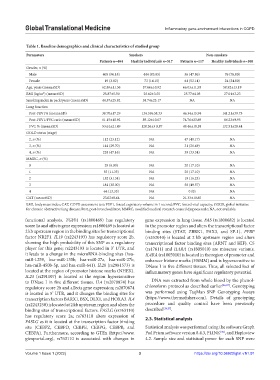
            Table 1. Baseline demographics and clinical characteristics of studied group
            Parameters                                  Smokers                          Non‑smokers
                                           Patients n=484  Healthy individuals n=517  Patients n=117  Healthy individuals n=100
            Gender, n (%)
             Male                            465 (96.18)      444 (85.85)       56 (47.86)       76 (76.00)
             Female                           19 (3.82)       73 (14.15)        61 (52.14)       24 (24.00)
            Age, years (mean±SD)            62.89±11.36       57.66±10.92      66.03±11.93      58.92±13.19
            BMI (kg/m ) (mean±SD)            25.87±5.50       26.62±3.55       25.77±4.05       27.01±3.23
                   2
            Smoking index in pack/years (mean±SD)  44.57±25.82  38.74±23.17       NA               NA
            Lung function
             Post-FEV1% (mean±SD)           38.70±17.29      136.59±38.33      46.34±15.94      141.21±39.75
             Post-FEV1/FVC ratio (mean±SD)  61.15±18.92       89.12±10.07      74.76±23.69      86.23±9.95
             FVC % (mean±SD)                53.61±21.49      128.26±3 0.87     49.46±18.58      132.91±28.44
            GOLD status (stage)
             2, n (%)                        112 (23.12)        NA              47 (40.17)         NA
             3, n (%)                        144 (29.70)        NA              31 (26.49)         NA
             4, n (%)                        228 (47.16)        NA              39 (33.34)         NA
            MMRC, n (%)
             0                                29 (6.00)         NA              20 (17.10)         NA
             1                               55 (11.33)         NA              20 (17.10)         NA
             2                               152 (31.34)        NA              19 (16.23)         NA
             3                               184 (38.00)        NA              58 (49.57)         NA
             4                               64 (13.33)         NA               0 (0)             NA
            CAT (mean±SD)                    23.02±8.64         NA             21.33±10.65         NA
            BMI, body mass index; CAT, COPD assessment test; FEV1, forced expiratory volume in 1 second; FVC, forced vital capacity; GOLD, global initiative
            for chronic obstructive lung disease; Post, post-bronchodilator; MMRC, modified medical research council dyspnea scale; NA, not available.

            functional analysis,  TGFb1 (rs1800469) has regulatory   gene expression in lung tissue. FAS (rs1800682) is located
            score 1a and affects gene expression; rs1800469 is located at   in the promoter region and alters the transcriptional factor
            2 kb upstream region in the binding sites for transcriptional   binding sites (STAT, ZBRK1, PAX3, and SP-1).  PPBP
            factor NR2F1. IL19 (rs2243193) has regulatory score 2b,   (rs352010) is located at 2 kb upstream region and alters
            showing the high probability of this SNP as a regulatory   transcriptional factor binding sites (ARNT and HIF). С5
            player for this gene; rs2243193 is located in 3’ UTR, and   (rs17611) and  IL4RA (rs1805010) are missense variants.
            it leads to a change in the microRNA-binding sites (hsa-  IL4RA (rs1805010) is located in the region of promoter and
            miR-1259, hsa-miR-135b, hsa-miR-27a, hsa-miR-27b,   enhancer histone marks (HSMM) and is hypersensitive to
            hsa-miR-450b-5p, and hsa-miR-641). IL20 (rs2981573) is   DNase I in five different tissues. Thus, all selected loci of
            located at the region of promoter histone marks (NHEK).   inflammatory genes have significant regulatory potential.
            IL24 (rs291107)  is located at the region hypersensitive
            to DNase I in five different tissues.  IL4 (rs2070874) has   DNA was extracted from whole blood by the phenol-
            regulatory score 2b and affects gene expression; rs2070874   chloroform protocol as described earlier [26,27] . Genotyping
            is located in 5’ UTR, and it changes the binding sites for   was performed using TaqMan SNP Genotyping Assays
            transcription factors BARX1, BSX, DLX1, and HOXA3. IL4   (https://www.thermofisher.com).  Details  of  genotyping
            (rs2243250) is located at 2 kb upstream region and alters the   procedure and quality control have been previously
            binding sites of transcriptional factors. FASLG (rs763110)   described [26,27] .
            has regulatory score 2a; rs763110 alters expression of   2.3. Statistical analysis
            FASLG as it is located at the transcription factor binding
            site  (CEBPZ,  CEBPD,  CEBPE,  CEBPG,  CEBPB,  and   Statistical analysis was performed using the software Graph
                                                                                               [30]
            CEBPA). Furthermore, according to GTEx (https://www.  Pad Prism software version 8.4.3, PLINK , and Haploview
            gtexportal.org),  rs763110  is associated with  changes  in   4.2. Sample size and statistical power for each SNP were

            Volume 1 Issue 1 (2022)                         3                       https://doi.org/10.36922/gtm.v1i1.91

