


Page 33 - GTM-1-2
P. 33
Global Translational Medicine                             Proteomic analysis of heart in metabolic cardiomyopathy


            chromatography system (Sciex Co.). The peptides were   2.7. Western blot
            concentrated on a 1.0-cm precolumn (75-µm inner    Total proteins from cells or tissue were lysed using RIPA
            diameter, 360-µm outer diameter, C18 5 µm, Sciex). The   buffer, and the protein concentration in the cell lysates was
            peptides were eluted from the precolumn using a gradient   assayed by a protein assay dye reagent concentrate (Bio-
            from 100% phase A (0.1% fatty acid aqueous solution) to   Rad,  USA).  Samples  were  separated  by  sodium  dodecyl
            45% phase B (0.1% fatty acid, 100% acetonitrile) in 75 min   sulfate-polyacrylamide gel electrophoresis (SDS-PAGE)
            at 300 nL/min directly onto an 15-cm analytical column   and then transferred to polyvinylidene fluoride (PVDF)
            (75-µm inner diameter, 360-µm outer diameter, ReproSil-  membranes (pore size 0.45 µm). After being blocked with
            Pur C18 3 µm, Sciex). The instrument was operated in a   5% bovine serum albumin for 1 h, the membranes were
            data-dependent mode automatically. Three biological   incubated with primary antibodies, including CPT1B
            replicates were prepared for each sample using a described   (1:1000), ACAA2  (1:1000), and tubulin (1:5000) at 4°C
            parameters (2500V+).                               overnight. After being washed with TBST, the membranes
                                                               were incubated with secondary antibodies for 1 h at room
            2.4. Data processing and assembly                  temperature. Finally, the protein bands were visualized
            Raw files from LC-MS were searched using the Mascot   by enhanced chemiluminescence kit (Santa Cruz, Texas,
            search engine human database 3.78 for data processing.   USA).
            Parameters were adjusted for: (i) trypsin digestion,
            with two maximum missed cleavage points permitted;   3. Results
            (ii) length of the digested peptide: 6 – 25; (iii) precursor   3.1. HFD-induced diabetic cardiomyopathy
            mass tolerance of 10  ppm and fragment mass tolerance   Given that over 80% of patients with MC are either
            adjusted to 0.2 Da; (iv) dynamic variation oxidation of   obese  or  diabetic,  we  employed  diet-induced  obesity  to
            methionine: static modification carbamidomethyl of   investigate the differential expressed proteins in the heart
            cysteine was selected; and (v) false discovery rate: < 1. The   tissues between normal heart and mice with MC, which
            level of peptide confidence for the data filter was adjusted   was induced by HFD. The experimental procedure is
            to “high.”                                         shown in Figure 1A.
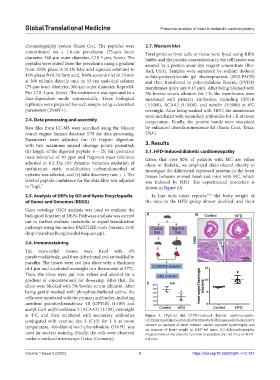
            2.5. Analysis of DEPs by GO and Kyoto Encyclopedia   In line with other reports, [15]  the body weight of
            of Genes and Genomes (KEGG)                        the mice in the HFD group almost doubled, and their
            Gene ontology (GO) analysis was used to evaluate the
            biological function of DEPs. Pathways analysis was carried   A          B
            out to further evaluate metabolic or signal transduction
            pathways using the online PANTHER tools (version 15.0)
            (http://pantherdb.org/invalid Request.jsp).

            2.6. Immunostaining
            The  myocardial  tissues  were  fixed  with  4%
            paraformaldehyde, and then dehydrated and embedded in
            paraffin. The hearts were cut into slices with a thickness
            of 4 µm and incubated overnight in a thermostat at 37°C.
            Then, the slices were put into xylene and alcohol (in a
            gradient of concentration) for dewaxing. After that, the   C
            slices were blocked with 5% bovine serum albumin. After
            being gently washed with phosphate-buffered saline, the
            cells were incubated with the primary antibodies, including
            carnitine  palmitoyltransferase  1B  (CPT1B)  (1:100)  and
            acetyl-CoA acyltransferase 2 (ACAA2) (1:100), overnight
            at 4°C, and then incubated with secondary antibodies   Figure  1.  High-fat diet (HFD)-induced diabetic cardiomyopathy.
            conjugated with cyanine dye 3 (Cy3) for 1  h at room   (A) Experimental procedure chart for this study. (B) Immunohistochemistry
            temperature. 4’,6-diamidino-2-phenylindole (DAPI) was   showed an increase of heart volume, cardiac myocyte hypertrophy and
                                                               an increase of heart weight in HFD-fed mice. (C) Echocardiographic
            used for nuclear staining. Finally, the cells were observed   measurement of the diastolic function in standard diet-fed mice or HFD-
            under a confocal microscope (Leica, Germany).      fed mice.


            Volume 1 Issue 2 (2022)                         3                      https://doi.org/10.36922/gtm.v1i2.137

