


Page 34 - GTM-1-2
P. 34
Global Translational Medicine                            Proteomic analysis of heart in metabolic cardiomyopathy


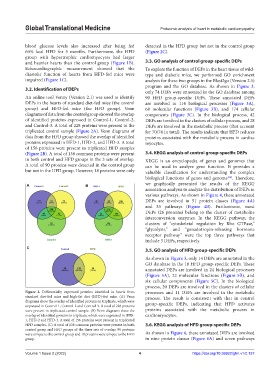
            blood  glucose  levels  also  increased  after  being  fed   detected in the HFD group but not in the control group
            60% kcal HFD for 5  months. Furthermore, the HFD   (Figure 2C).
            group with hypertrophic cardiomyocytes had larger
            and heavier hearts than the control group (Figure 1B).   3.3. GO analysis of control group-specific DEPs
            Echocardiographic measurement showed that the      To explore the function of DEPs in the heart tissue of wild-
            diastolic function of hearts from HFD-fed mice were   type and diabetic mice, we performed GO enrichment
            impaired (Figure 1C).                              analysis for these two groups in the Blast2go (Version 2.5)
                                                               program and the GO database. As shown in  Figure  3,
            3.2. Identification of DEPs
                                                               only 74 DEPs were annotated in the GO database among
            An online tool Venny (Version 2.1) was used to identify   90 HFD group-specific DEPs. These annotated DEPs
            DEPs in the hearts of standard diet-fed mice (the control   are involved in 114 biological processes (Figure  3A),
            group) and HFD-fed mice (the HFD group). Venn      68 molecular functions (Figure  3B), and 174 cellular
            diagrams of data from the control group showed the overlap   components (Figure  3C). In the biological process, 42
            of identified proteins expressed in Control-1, Control-2,   DEPs are involved in the clusters of cellular process, and 28
            and Control-3. A total of 228 proteins were present in the   DEPs are involved in the metabolic process (that account
            triplicated control sample (Figure 2A). Venn diagrams of   for 70/74 in total). The results indicate that HFD reduces
            data from the HFD group showed the overlap of identified   proteins associated with the metabolic process in cardiac
            proteins expressed in HFD-1, HFD-2, and HFD-3. A total   myocytes.
            of 156 proteins were present in triplicated HFD samples
            (Figure 2B). A total of 138 common proteins were present   3.4. KEGG analysis of control group-specific DEPs
            in both control and HFD groups in the 3 sets of overlap.   KEGG is an encyclopedia of genes and genomes that
            A total of 90 proteins were detected in the control group   can be used to analyze gene function. It provides a
            but not in the HFD group. However, 18 proteins were only   valuable  classification  for  understanding  the  complex
                                                                                                  [16]
                                                               biological functions of genes and genome . Therefore,
            A                        B                         we  graphically presented the results of the KEGG
                                                               annotation analysis to analyze the distribution of DEPs in
                                                               various pathways. As shown in Figure 4, these annotated
                                                               DEPs are involved in 51 protein classes (Figure  4A)
                                                               and 33  pathways (Figure  4B).  Furthermore, most
                                                               DEPs  (26 proteins)  belong to  the cluster  of metabolite
                                                               interconversion enzymes. In  the KEGG  pathway, the
                                                               clusters of “cytoskeletal regulation by Rho GTPase,”
                                                               “glycolysis,” and “gonadotropin-releasing hormone
                                                               receptor pathway” were the top three pathways that
                                                               include 3 DEPs, respectively.
            C                                                  3.5. GO analysis of HFD group-specific DEPs

                                                               As shown in Figure 3, only 14 DEPs are annotated in the
                                                               GO database in the 18 HFD group-specific DEPs. These
                                                               annotated DEPs are involved in 24 biological processes
                                                               (Figure  5A), 22 molecular functions (Figure  5B), and
                                                               six cellular components (Figure  5C). In the biological
                                                               process, 20 DEPs are involved in the clusters of cellular
            Figure  2.  Differentially  expressed  proteins  identified  in  hearts  from   processes and 11 DEPs are involved in the metabolic
            standard  diet-fed  mice  and  high-fat  diet  (HFD)-fed  mice.  (A)  Venn   process. The result is consistent with that in control
            diagrams show the overlap of identified proteins in triplicate, which were   group-specific DEPs, indicating that HFD activates
            expressed in Control-1, Control-2 and Control-3. A total of 228 proteins
            were present in triplicated control sample. (B) Venn diagrams show the   proteins associated with the metabolic process in
            overlap of identified proteins in triplicate, which were expressed in HFD-  cardiomyocytes.
            1, HFD-2 and HFD-3. A total of 156 proteins were present in triplicated
            HFD samples. (C) A total of 138 common proteins were present in both   3.6. KEGG analysis of HFD group-specific DEPs
            control group and HFD groups of the three sets of overlap; 90 proteins
            were unique to the control group and 18 proteins were unique to the HFD   As shown in Figure 6, these annotated DEPs are involved
            group.                                             in nine protein classes (Figure  6A) and seven pathways


            Volume 1 Issue 2 (2022)                         4                      https://doi.org/10.36922/gtm.v1i2.137

