


Page 48 - IJAMD-1-2
P. 48
International Journal of AI for
            Materials and Design
                                                                                  A unified ILKM in smart manufacturing


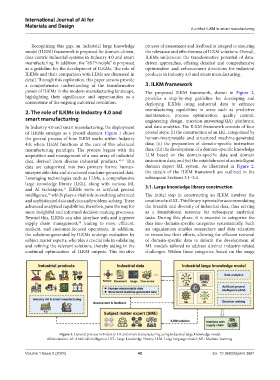
              Recognizing this gap, an industrial large knowledge   process of assessment and feedback is integral to ensuring
            model (ILKM) framework is proposed for domain-driven,   the relevance and effectiveness of ILKM solutions. Overall,
            data-centric industrial systems in Industry 4.0 and smart   ILKMs underscore the transformative potential of data-
            manufacturing. In addition, the “6S Principle” is proposed   driven approaches, offering detailed and comprehensive
            as a guideline for the development of ILKMs. The role of   optimization and enhancement directions for industrial
            ILKMs and their comparison with LLMs are discussed in   products in Industry 4.0 and smart manufacturing.
            detail. Through this exploration, this paper aims to provide
            a comprehensive understanding of the transformative   3. ILKM framework
            power of ILKMs in the modern manufacturing landscape,   The proposed ILKM framework, shown in  Figure  2,
            highlighting their significance and opportunities as a   provides a step-by-step guideline for developing and
            cornerstone of the ongoing industrial revolution.  deploying  ILKMs  using  industrial data  to enhance

            2. The role of ILKMs in Industry 4.0 and           manufacturing capabilities  in areas  such as  predictive
                                                               maintenance, process optimization, quality control,
            smart manufacturing                                engineering design, question-answering(QA) platforms,
            In Industry 4.0 and smart manufacturing, the deployment   and data analytics. The ILKM framework consists of four
            of ILKMs  emerges  as a pivotal  element.  Figure  1 shows   pivotal steps: (i) the construction of an LKL categorized by
            the general process of how ILKM works within Industry   human-interpretable  and  structured  machine-generated
            4.0, where ILKM functions at the core of this advanced   data; (ii) the preparation of domain-specific instruction
            manufacturing paradigm. The process begins with the   data; (iii) the development of a domain-specific knowledge
            acquisition and management of a vast array of industrial   LLM based on the domain-specific data and domain
            data, derived from diverse industrial products. 10,11  This   instruction data; and (iv) the establishment of an intelligent
            data are categorized into two primary forms: human-  domain expert ML system. As illustrated in  Figure  2,
            interpretable data and structured machine-generated data.   the  details  of  the  ILKM  framework  are  outlined  in  the
            Leveraging technologies such as LLMs, a comprehensive   subsequent Sections 3.1–3.4.
            large knowledge library (LKL), along with various ML   3.1. Large knowledge library construction
            and AI techniques,  ILKMs serve as artificial general
                            12
            intelligence,  which plays a vital role in enabling advanced   The initial step in constructing an ILKM involves the
                     13
            and sophisticated data analytics and problem-solving. These   creation of an LKL. This library is pivotal for accommodating
            advanced analytical capabilities, therefore, pave the way for   the breadth and diversity of industrial data, thus serving
            more insightful and informed decision-making processes.   as a foundational resource for subsequent analytical
            Beyond this, ILKMs can also interface with and improve   tasks. During this phase, it is essential to categorize  the
            supply chain management,  leading to more efficient,   data into domain-specific categories systematically. Such
                                  14
            resilient, and customer-focused operations. In addition,   an  organization  enables  researchers  and data scientists
            the solutions generated by ILKMs undergo evaluation by   to streamline their efforts, allowing for efficient retrieval
            subject matter experts, who play a crucial role in validating   of domain-specific data to inform the development of
            and refining the relevant solutions, thereby aiding in the   ML  models  tailored  to address distinct industry-related
            continual optimization of ILKM outputs. This iterative   challenges. Within these categories, based on the usage


                          Figure 1. General process in Industry 4.0 and smart manufacturing using industrial large knowledge model
                     Abbreviations: AI: Artificial intelligence; LKL: Large knowledge library; LLM: Large language model; ML: Machine learning.


            Volume 1 Issue 2 (2024)                         42                             doi: 10.36922/ijamd.3681

