


Page 50 - IJAMD-1-2
P. 50
International Journal of AI for
            Materials and Design
                                                                                  A unified ILKM in smart manufacturing


            3.4. Intelligent domain expert ML system           specific industrial tasks, utilizing relevant structured

            Upon the successful training of the domain knowledge   industrial data and domain-specific knowledge to provide
            LLM, the fourth step involves utilizing it as a domain   precise, expert-level solutions. In contrast, LLMs are more
            expert for subsequent specialized model development.   generalized, leveraging extensive training on diverse
                                                               textual data to solve language-related tasks, such as text
            In this step, domain instruction data serves as the   generation, conversation, and language translation. To
            prompt, propelling the LLM to address specific analytical   better illustrate the characteristics of ILKMs,  a detailed
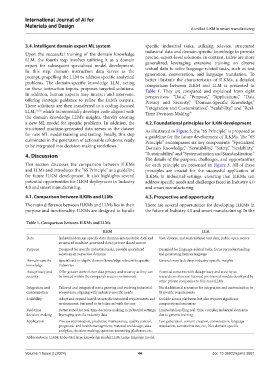
            problems.  The  domain-specific  knowledge  LLM,  acting   comparison between ILKM and LLM is presented in
            on these instruction inputs, proposes targeted solutions.   Table 1. They are compared and explained from eight
            In  addition,  human  experts  may  interact  and  intervene,   perspectives: “Data,” “Purpose,” “Applications,” “Data
            offering strategic guidance to refine the LLM’s outputs.   Privacy and Security,” “Domain-Specific Knowledge,”
            These solutions are then transferred to a coding-focused   “Integration and Customization,” “Scalability,” and “Real-
            LLM, 25,26  which incrementally develops code aligned with   Time Decision-Making.”
            the  domain knowledge  LLM’s  insights,  thereby  creating
            a new ML model for specific problems. In addition, the   4.2. Foundational principles for ILKM development
            structured machine-generated data serves as the dataset   As illustrated in Figure 3, the “6S Principle” is proposed as
            for new ML model training and testing. Finally, this step   a guideline for the future development of ILKMs. The “6S
            culminates in the generation of actionable solutions, ready   Principle” encompasses six key components: “Specialized
            to be integrated into decision-making workflows.   Domain Knowledge,” “Scrutability,” “Safety,” “Scalability,”
            4. Discussion                                      “Sustainability,” and “Systematization and Standardization.”
                                                               The details of the purpose, challenges, and opportunities
            This section discusses the comparison between ILKMs   for each principle are presented in Figure 3. All of these
            and LLMs and introduces the “6S Principle” as a guideline   principles are crucial for the successful application of
            for future ILKM development. It also highlights several   ILKMs in industrial settings, ensuring that ILKMs can
            potential opportunities for ILKM deployment in Industry   address specific needs and challenges faced in Industry 4.0
            4.0 and smart manufacturing.                       and smart manufacturing.

            4.1. Comparison between ILKMs and LLMs             4.3. Prospective and opportunity
            The main difference between ILKMs and LLMs lies in their   There are several opportunities for developing ILKMs in
            purpose and functionality. ILKMs are designed to handle   the future of Industry 4.0 and smart manufacturing. In the

            Table 1. Comparison between ILKMs and LLMs

                                             ILKM                                      LLM
            Data          Industrial domain-specific data (human-interpretable data and   Vast, diverse, and unstructured text data; public open source
                          structured machine-generated data); private closed source
            Purpose       Designed for specific industrial tasks; provide specialized   Designed for language-related tasks; focus on understanding
                          solutions in respective domains            and generating human language
            Domain-specific   Specialized: in-depth, domain knowledge relevant to specific   General: may lack deep, industry-specific insights
            knowledge     industries
            Data privacy and   Offer greater control over data privacy and security as they can   Potential concerns with data privacy and security as
            security      be hosted within the company’s secure environment  researchers often use licensed pre-trained models developed by
                                                                     other private companies to fine-tune LLMs
            Integration and   Tailored and integrated into a growing and evolving industrial   Need additional resources for integration and customization to
            customization  ecosystems, aligning with industry-specific needs  fit specific requirements
            Scalability   Adapt and expand based on specific industrial requirements and  Scalable across platforms but also requires significant
                          environment, but need to be balanced with the cost  computational resources
            Real-time     Better suited for real-time decision-making in industrial settings,  Limited in handling real-time, complex industrial decisions
            decision-making  leveraging specific industry data       due to generic training
            Application   Process optimization, predictive maintenance, quality control,   Text generation, content creation, conversation, language
                          prognostic and health management, material and design, data   translation, summarization, etc., Not domain specific
                          analytics, decision-making, question-answering platforms, etc.
            Abbreviations: ILKM: Industrial large knowledge model; LLM: Large language model.


            Volume 1 Issue 2 (2024)                         44                             doi: 10.36922/ijamd.3681

