


Page 59 - IJAMD-1-2
P. 59
International Journal of AI for
            Materials and Design
                                                                             AI-assisted ML monitoring in additive auxetics


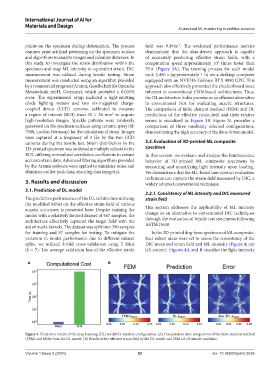
            points  on  the  specimen  during  deformation.  The  process   field was 9.464e . The evaluated performance metrics
                                                                             -5
            requires prior artificial patterning on the specimen surface   demonstrate that the data-driven approach is capable
            and algorithms to analyze images and calculate distances. In   of accurately predicting effective strain fields, with a
            this study, to investigate the strain distribution within the   computation speed approximately 10   times faster than
                                                                                              4
            specimen and map ML intensity to equivalent strain, DIC   FEA (Figure  3A). The training process for each model
            measurement was utilized during tensile testing. Strain   took 3,456 s (approximately 1 h) on a desktop computer
            measurement was conducted using an algorithm provided   equipped with an NVIDIA GeForce RTX 4090 GPU. This
            by a commercial program (Aramis, Gesellschaft für Optische   approach also effectively prevented the checkerboard issue
            Messtechnik mbH, Germany), which provided a 0.005%   inherent in conventional CNN-based architectures. Thus,
            error. The experimental setup included a light-emitting   the DL architecture holds promise as an efficient alternative
            diode lighting system and two six-megapixel charge-  to conventional FEA for evaluating auxetic structures.
            coupled device (CCD) cameras, calibrated to measure   The comparison of finite element method (FEM) and DL
            a region of interest (ROI) sized 30 × 24 mm  to acquire   predictions of the effective strain field and their relative
                                                 2
            high-resolution images. Speckle patterns were randomly   errors is visualized in  Figure  3B.  Figure S1 provides a
            generated on the specimen surfaces using ceramic spray (SF   comparison of three randomly selected configurations,
            7900, Loctite, Germany) for the calculation of strain. Images   demonstrating the high accuracy of the data-driven model.
            were  captured  at  a  frequency  of  3  Hz  by  the  two  CCD
            cameras during the tensile test. Strain distribution in the   3.2. Evaluation of 3D-printed ML composite
            3D-printed specimen was analyzed at multiple subsets in the   specimen
            ROI, utilizing normalized correlation coefficients to extract   In this section, we evaluate and analyze the luminescence
            accurate strain data. Advanced filtering algorithms provided   behavior of 3D-printed ML composite specimens by
            by the Aramis software were applied to minimize noise and   measuring and quantifying light intensity upon loading.
            eliminate outlier peak data, ensuring data integrity).  We demonstrate that the ML-based non-contact evaluation
                                                               technique can capture the strain field measured by DIC, a
            3. Results and discussion                          widely adopted conventional technique.

            3.1. Prediction of DL model
                                                               3.2.1. Consistency of ML intensity and DIC measured
            The predictive performance of the DL architecture utilizing   strain field
            the modified MNet on the effective strain field of various
            auxetic structures is presented here. Despite training the   This  section  addresses  the  applicability  of  ML  intensity
            model with a relatively limited dataset of 487 samples, the   change as an alternative to conventional DIC techniques
            architecture effectively captured the target field with the   through the evaluation of tensile test specimens following
            aid of multi-kernels. The dataset was split into 390 samples   ASTM D638.
            for training and 97  samples for testing. To mitigate the   In the 3D-printed dog-bone specimen of ML composite,
            variation in model performance due  to different dataset   four subset areas were set to assess the consistency of the
            splits, we utilized  k-fold cross-validation using 5 folds   DIC measured strain field and ML intensity (Figure 4; top
            (k = 5). The average validation loss of the effective strain   left corner). Figures 4A and B visualize the light intensity

             A                                 B


            Figure 3. Prediction results of the deep learning (DL) model for random configuration. (A) Computation time comparison of the finite element method
            (FEM) and MNet from the DL model. (B) Results of the effective strain field by the DL model and FEM a 0.1% tensile condition.


            Volume 1 Issue 2 (2024)                         53                             doi: 10.36922/ijamd.3539

