


Page 60 - IJAMD-1-2
P. 60
International Journal of AI for
            Materials and Design
                                                                             AI-assisted ML monitoring in additive auxetics


                            A                     B                       C


                            D


                                                                    F
             E


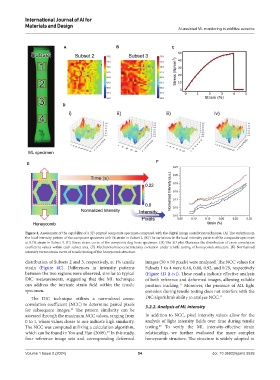
            Figure 4. Assessment of the capability of a 3D-printed composite specimen compared with the digital image correlation technique. (A) The variations in
            the local intensity pattern of the composite specimen at 0.1% strain in Subset 2. (B) The variations in the local intensity pattern of the composite specimen
            at 0.1% strain in Subset 3. (C) Stress-strain curve of the composite dog-bone specimen. (D) The 3D plot illustrates the distribution of cross-correlation
            coefficient values within each subset area. (E) Mechanoluminescent intensity evolution under tensile testing of honeycomb structure. (F) Normalized
            intensity versus strain curve of tensile testing of the honeycomb structure.

            distribution of Subsets 2 and 3, respectively, at 1% tensile   images (50 × 50 pixels) were analyzed. The NCC values for
            strain (Figure  4C). Differences in intensity patterns   Subsets 1 to 4 were 0.48, 0.88, 0.92, and 0.79, respectively
            between the two regions were observed, similar to typical   (Figure 4D [i-iv]). These results indicate effective analysis
            DIC measurements, suggesting that the ML technique   of both reference and deformed images, allowing reliable
            can address the intricate strain field within the tensile   position tracking.  Moreover, the presence of ML light
                                                                             11
            specimen.                                          emission during tensile testing does not interfere with the
              The DIC technique utilizes a normalized cross-   DIC algorithm’s ability to analyze NCC. 11
            correlation coefficient (NCC) to determine paired pixels   3.2.2. Analysis of ML intensity
            for subsequent images.  The pattern similarity can be
                               11
            assessed through the maximum NCC values, ranging from   In addition to NCC, pixel  intensity values  allow for  the
            0 to 1, where values closer to one indicate high similarity.   analysis of light intensity fields over time during tensile
                                                                     45
            The NCC was computed utilizing a calculation algorithm,   testing.  To verify the ML intensity-effective strain
            which can be found in Yoo and Han (2009).  In this study,   relationship, we further evaluated the more complex
                                              44
            four reference image sets and corresponding deformed   honeycomb structure. The structure is widely adopted in

            Volume 1 Issue 2 (2024)                         54                             doi: 10.36922/ijamd.3539

