


Page 56 - IJAMD-1-2
P. 56
International Journal of AI for
            Materials and Design
                                                                             AI-assisted ML monitoring in additive auxetics


            A


            B


            C


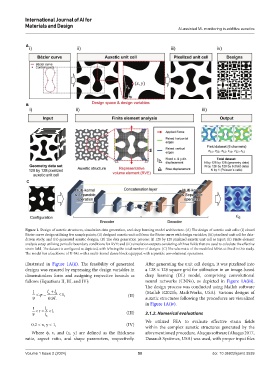
            Figure 1. Design of auxetic structures, simulation data generation, and deep learning model architecture. (A) The design of auxetic unit cells: (i) closed
            Bézier curve design utilizing few sample points; (ii) designed auxetic unit cell from the Bézier curve with design variables; (iii) pixelized unit cell for data-
            driven study; and (iv) generated auxetic designs. (B) The data generation process: (i) 128 by 128 pixelized auxetic unit cell as input; (ii) Finite element
            analysis setup utilizing periodic boundary conditions for RVE; and (iii) simulation outputs consisting of three fields that are used to calculate the effective
            strain field. The dataset is configured as depicted, with N being the total number of designs. (C) The schematic of the modified MNet utilized in this study.
            The model has a backbone of U-Net with a multi-kernel dense block equipped with separable convolutional operations.
            illustrated in  Figure  1A(ii). The feasibility of generated   After generating the unit cell design, it was pixelized into
            designs was ensured by expressing the design variables in   a 128 × 128 square grid for utilization in an image-based
            dimensionless form and assigning respective bounds as   deep learning (DL) model, comprising convolutional
            follows (Equations II, III, and IV):               neural networks (CNNs), as depicted in  Figure  1A(iii).
                                                               The design process was conducted using Matlab software
               1  <  ϕ =  l a  + l b  ≤  1,                    (Matlab R2021b, MathWorks, USA). Various designs of
               9      0.9L                             (II)    auxetic structures following the procedures are visualized
                                                               in Figure 1A(iv).
               1  <=  l a  <1,
                 τ
               9    l b                                (III)   2.1.2. Numerical evaluations
                                                               We utilized FEA to evaluate effective strain fields
              0.2 < x, y < 1,                          (IV)
                                                               within  the  complex  auxetic  structures  generated  by  the
              Where  φ,  τ, and (x, y) are defined as the thickness   aforementioned procedure. Abaqus software (Abaqus 2017,
            ratio, aspect ratio, and shape parameters, respectively.   Dassault Systèmes, USA) was used, with proper input files


            Volume 1 Issue 2 (2024)                         50                             doi: 10.36922/ijamd.3539

