


Page 61 - IJAMD-1-2
P. 61
International Journal of AI for
            Materials and Design
                                                                             AI-assisted ML monitoring in additive auxetics


            sensor applications for its lightweight and efficient stress   conversion aligns with the output field dataset shown in
            distribution.  Considering that the structure has been   Figure 1B [iii]. For calibration between effective strain and
                      46
            extensively analyzed and documented in the literature,   ML intensity, bicubic interpolation was implemented,
                                                                                                            47
            it provides  a robust foundation for understanding and   using four subset windows of 25 × 25 pixels.
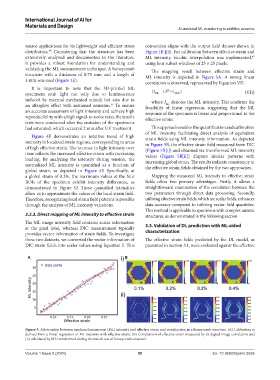
            validating the ML measurement technique. A honeycomb   The mapping result between effective strain and
            structure with a thickness of 0.75  mm and a length of   ML intensity is depicted in  Figure  5A. A  strong linear
            3 mm was used (Figure 4E).                         correlation is observed, represented by Equation VII:

              It is important to note that the 3D-printed ML
            specimens emit light not only due to luminescence     (I ML  =137 × ε equiv )                (VII)
            induced  by external  mechanical stimuli but  also  due to   where I  denotes the ML intensity. This confirms the
                                                                        ML
            an afterglow effect with sustained emission.  To ensure   feasibility of linear regression, suggesting that the ML
                                                45
            an accurate assessment of light intensity and achieve high   response of the specimen is linear and proportional to the
            reproducibility with a high signal-to-noise ratio, the tensile   effective strain.
            tests were conducted after the emission of the specimens
            had saturated, which occurred 2 min after UV treatment.  This approach enables the quantification and calibration
                                                               of  ML  intensity,  facilitating  direct  analysis  of  equivalent
              Figure  4E  demonstrates an intuitive trend of high   strain fields using ML intensity information. As depicted
            intensity in localized strain regions, corresponding to areas   in Figure 5B, the effective strain field measured from DIC
            of high effective strain. The increase in light intensity over   (Figure 5B[i]) and obtained via transformed ML intensity
            time reflects the increased effective strain with increasing   values  (Figure  5B[ii]) displays  similar patterns with
            loading. By analyzing the intensity during tension, the   increasing global strain. The results indicate consistency in
            normalized ML  intensity is  quantified as  a  function  of   the effective strain fields obtained by the two approaches.
            global strain, as depicted in  Figure  4F. Specifically, at
            a global strain of 0.3%, the maximum values at the four   Mapping the measured ML intensity to effective strain
            ROIs of the specimen exhibit intensity differences, as   fields offers two primary advantages. Firstly, it allows a
            demonstrated in  Figure S2. These quantified intensities   straightforward examination of the correlation between the
            allow us to approximate the values of the local strain field.   two parameters through direct data processing. Secondly,
            Therefore, recognizing local strain field patterns is possible   utilizing effective strain fields, which are scalar fields, enhances
            through the analysis of ML intensity variations.   data accuracy compared to utilizing vector field quantities.
                                                               This method is applicable to specimens with complex auxetic
            3.2.3. Direct mapping of ML intensity to effective strain  structures, as demonstrated in the following section.
            The ML image intensity field contains scalar information
            at the pixel level, whereas DIC measurement typically   3.3. Validation of DL prediction with ML-aided
            provides vector information of strain fields. To investigate   characterization
            these two datasets, we converted the vector information of   The effective strain fields predicted by the DL model, as
            DIC strain fields into scalar values using Equation 5. This   presented in Section 3.1, were evaluated against the effective


             A                                        B


            Figure 5. Relationship between mechanoluminescent (ML) intensity and effective strain and visualization in a honeycomb structure. (A) Calibration is
            derived from a linear regression of ML intensity with effective strain. (B) Comparison of effective strain measured by (i) digital image correlation and
            (ii) calculated by ML transformed during the tensile test of honeycomb structure.


            Volume 1 Issue 2 (2024)                         55                             doi: 10.36922/ijamd.3539

