


Page 70 - IJAMD-1-2
P. 70
International Journal of AI for
            Materials and Design
                                                                               Machine learning for gel fraction prediction


                         A


                         B


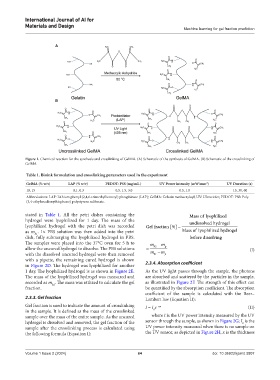
            Figure 1. Chemical reaction for the synthesis and crosslinking of GelMA. (A) Schematic of the synthesis of GelMA. (B) Schematic of the crosslinking of
            GelMA.

            Table 1. Bioink formulation and crosslinking parameters used in the experiment
            GelMA (% w/v)     LAP (% w/v)     PEDOT: PSS (mg/mL )    UV Power intensity (mW/mm )  UV Duration (s)
                                                                                         2
            10, 15              0.1, 0.3          0.5, 1.5, 3.0              0.5, 1.0               15, 30, 60
            Abbreviations: LAP: Lithium phenyl (2,4,6-trimethylbenzoyl) phosphinate (LAP); GelMA: Gelatin methacryloyl; UV: Ultraviolet; PEDOT: PSS: Poly
            (3,4-ethylenedioxythiophene) polystyrene sulfonate.

            stated in  Table 1. All the petri dishes containing the               Mass of lyophilized
            hydrogel  were  lyophilized  for  1  day.  The  mass  of  the         undissolved hydrogel
            lyophilized  hydrogel  with  the  petri  dish  was  recorded   Gelfraction%
            as  m .  1×  PBS  solution  was  then  added  into  the  petri    Mass of lyyophilized hydrogel
                h1
            dish, fully submerging the lyophilized hydrogel in PBS.               before dissolving
            The samples were placed into the 37°C oven for 5 h to   m  m
            allow the uncured hydrogel to dissolve. The PBS solutions     h2  p                           (I)
            with the dissolved uncured hydrogel were then removed   m h1  m p
            with a pipette, the remaining cured hydrogel is shown   2.3.4. Absorption coefficient
            in Figure 2D. The hydrogel was lyophilized for another
            1 day. The lyophilized hydrogel is as shown in Figure 2E.   As the UV light passes through the sample, the photons
            The mass of the lyophilized hydrogel was measured and   are absorbed and scattered by the particles in the sample,
            recorded as m . The mass was utilized to calculate the gel   as illustrated in Figure 2F. The strength of this effect can
                       h2
            fraction.                                          be quantified by the absorption coefficient. The absorption
                                                               coefficient of the sample is calculated with the Beer–
            2.3.3. Gel fraction                                Lambert law (Equation II):
            Gel fraction is used to indicate the amount of crosslinking   I = I e −ax                      (II)
            in the sample. It is defined as the mass of the crosslinked   0
            sample over the mass of the entire sample. As the uncured   where I is the UV power intensity measured by the UV
            hydrogel is dissolved and removed, the gel fraction of the   sensor through the sample, as shown in Figure 2G; I  is the
                                                                                                        0
            sample after the crosslinking process is calculated using   UV power intensity measured when there is no sample on
            the following formula (Equation I):                the UV sensor, as depicted in Figure 2H; x is the thickness


            Volume 1 Issue 2 (2024)                         64                             doi: 10.36922/ijamd.3807

