


Page 71 - IJAMD-1-2
P. 71
International Journal of AI for
            Materials and Design
                                                                               Machine learning for gel fraction prediction


                         A                  B             D


                         C
                                                          E


                         F                     G                       H


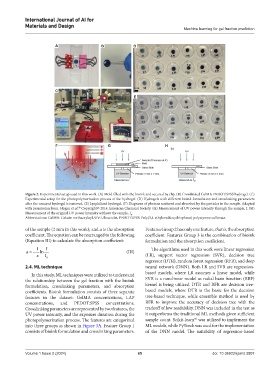
            Figure 2. Experimental setup used in this work. (A) Mold filled with the bioink and secured by clip. (B) Crosslinked GelMA-PEDOT:SPSS hydrogel. (C)
            Experimental setup for the photopolymerization process of the hydrogel. (D) Hydrogels with different bioink formulation and crosslinking parameters
            after the uncured hydrogel is removed. (E) Lyophilized hydrogel. (F) Diagrams of photons scattered and absorbed by the particles in the sample. Adapted
            with permission from. Hogan et al.  Copyright© 2014 American Chemical Society. (G) Measurement of UV power intensity through the sample, I. (H)
                                  49
            Measurement of the original UV power intensity without the sample, I .
                                                         0
            Abbreviations: GelMA: Gelatin methacryloyl, UV: Ultraviolet, PEDOT:SPSS: Poly(3,4-ethylenedioxythiophene) polystyrene sulfonate.
            of the sample (2 mm in this work); and a is the absorption   Features Group 2 has only one feature, that is, the absorption
            coefficient. The equation can be rearranged to the following   coefficient. Features Group 3 is the combination of bioink
            (Equation III) to calculate the absorption coefficient:  formulation and the absorption coefficient.
                 1  I                                            The algorithms used in this work were linear regression
            a  ln                                    (III)
                 x  I 0                                        (LR), support vector regression (SVR), decision tree
                                                               regressor (DTR), random forest regression (RFR), and deep
            2.4. ML technique                                  neural network (DNN). Both LR and SVR are regression-
              In this study, ML techniques were utilized to understand   based  models, where LR  assumes  a linear  model,  while
            the relationship between the gel fraction with the bioink   SVR is a non-linear model as radial basis function (RBF)
            formulation, crosslinking parameters, and absorption   kernel is being utilized. DTR and RFR are decision tree-
            coefficients. Bioink formulation consists of three separate   based models, where DTR is the basic for the decision
            features in the dataset: GelMA concentrations, LAP   tree-based technique, while ensemble method is used by
            concentrations,  and  PEDOT:SPSS  concentrations.  RFR to improve the accuracy of decision tree with the
            Crosslinking parameters are represented by two features, the   tradeoff of low readability. DNN was included in the test as
            UV power intensity, and the exposure duration during the   it outperforms the traditional ML methods given sufficient
                                                                                    50
            photopolymerization process. The features are categorized   sample count. Scikit-learn  was utilized to implement the
            into three groups as shown in Figure 3A. Feature Group 1   ML models, while PyTorch was used for the implementation
            consists of bioink formulation and crosslinking parameters.   of the DNN model. The suitability of regression-based


            Volume 1 Issue 2 (2024)                         65                             doi: 10.36922/ijamd.3807

