


Page 76 - IJAMD-1-2
P. 76
International Journal of AI for
            Materials and Design
                                                                               Machine learning for gel fraction prediction


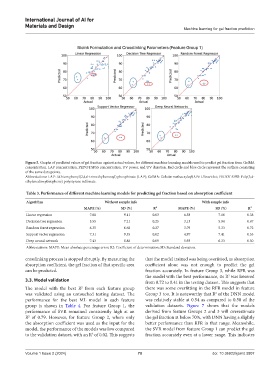
            Figure 5. Graphs of predicted values of gel fraction against actual values, for different machine learning models used to predict gel fraction from GelMA
            concentration, LAP concentration, PEDOT:SPSS concentration, UV power, and UV duration. Red circle and blue circle represent the outliers consisting
            of the same data points.
            Abbreviations: LAP: Lithium phenyl(2,4,6-trimethylbenzoyl) phosphinate (LAP); GelMA: Gelatin methacryloyl; UV: Ultraviolet; PEDOT:SPSS: Poly(3,4-
            ethylenedioxythiophene) polystyrene sulfonate.
            Table 3. Performance of different machine learning models for predicting gel fraction based on absorption coefficient

            Algorithm                         Without sample info                      With sample info
                                     MAPE (%)        SD (%)       R²         MAPE (%)        SD (%)       R²
            Linear regression          7.88           9.11        0.03         6.58           7.16        0.38
            Decision tree regression   5.55           7.21        0.25         3.13           5.94        0.67
            Random forest regression   6.35           6.68        0.27         3.79           5.33        0.72
            Support vector regression  7.31           9.35        0.02         4.97           7.41        0.53
            Deep neural network        7.43           8.88        0.09         5.93           6.33        0.50
            Abbreviations: MAPE: Mean absolute percentage error; R2: Coefficient of determination; SD: Standard deviation.

            crosslinking process is stopped abruptly. By measuring the   that the model trained was being overfitted, as absorption
            absorption coefficient, the gel fraction of that specific area   coefficient alone was not enough to predict the gel
            can be predicted.                                  fraction accurately. In feature Group  3, while RFR was
                                                               the model with the best performance, its R  was lowered
                                                                                                  2
            3.3. Model validation                              from 0.72 to 0.41 in the testing dataset. This suggests that
            The model with the best R  from each feature group   there was some overfitting in the RFR model in feature
                                    2
            was validated using an untouched testing dataset. The   Group 3 too. It is noteworthy that R  of the DNN model
                                                                                             2
            performance for the best ML model in each feature   was relatively stable at 0.54 as compared to 0.50 of the
            group is shown in  Table 4. For feature Group  1, the   validation datasets.  Figure  7 shows that the models
            performance of SVR remained consistently high at an   derived  from feature  Groups  2  and 3  will overestimate
            R  of 0.79. However, for feature Group  2, where only   the gel fraction at below 70%, with DNN having a slightly
             2
            the absorption coefficient was used as the input for the   better performance than RFR in that range. Meanwhile,
            model, the performance of the models was low compared   the SVR model from feature Group 1 can predict the gel
            to the validation dataset, with an R  of 0.02. This suggests   fraction accurately even at a lower range. This indicates
                                        2


            Volume 1 Issue 2 (2024)                         70                             doi: 10.36922/ijamd.3807

