


Page 77 - IJAMD-1-2
P. 77
International Journal of AI for
            Materials and Design
                                                                               Machine learning for gel fraction prediction


                         A


                         B


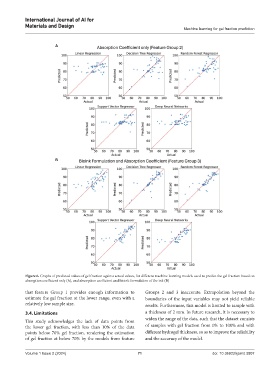
            Figure 6. Graphs of predicted values of gel fraction against actual values, for different machine learning models used to predict the gel fraction based on
            absorption coefficient only (A), and absorption coefficient and bioink formulation of the ink (B)

            that feature Group  1 provides enough information to   Groups  2 and 3 inaccurate. Extrapolation beyond the
            estimate the gel fraction at the lower range, even with a   boundaries of the input variables may not yield reliable
            relatively low sample size.                        results. Furthermore, this model is limited to sample with
            3.4. Limitations                                   a thickness of 2 mm. In future research, it is necessary to
            This study acknowledges the lack of data points from   widen the range of the data, such that the dataset consists
            the lower gel fraction, with less than 10% of the data   of samples with gel fraction from 0% to 100% and with
            points below 70% gel fraction, rendering the estimation   different hydrogel thickness, so as to improve the reliability
            of gel fraction at below 70% by the models from feature   and the accuracy of the model.


            Volume 1 Issue 2 (2024)                         71                             doi: 10.36922/ijamd.3807

