


Page 90 - IJAMD-1-3
P. 90
International Journal of AI for
            Materials and Design
                                                                            Review of gas turbine blade failures by erosion


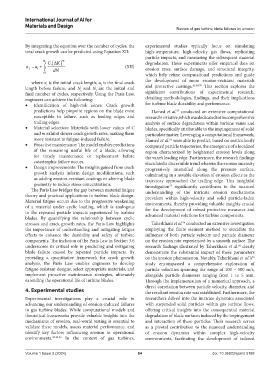
            By integrating the equation over the number of cycles, the   experimental studies typically focus on simulating
            total crack growth can be predicted using Equation XII:  high-temperature, high-velocity gas flows, replicating
                                                               particle impacts, and measuring the subsequent material
                   N f  C ∆ ( .  K) m                          degradation. These experiments offer empirical data on
                 i ∫
            a = a +                                   (XII)    erosion  rates,  surface damage, and structural  integrity,
             f
                                                               which help refine computational predictions and guide
                    N i  dN
              where a is the initial crack length; a is the final crack   the development of more erosion-resistant materials
                                            f
                     i
            length before failure; and  N and  N are the initial and   and protective coatings. 41,58,78  This section explores the
                                   i
                                          f
            final number of cycles, respectively. Using the Paris Law,   significant contributions of experimental research,
            engineers can achieve the following:               detailing methodologies, findings, and their implications
            •   Identification of high-risk zones: Crack growth   for turbine blade durability and performance.
               predictions help pinpoint regions on the blade most   Hamed et al.  conducted an extensive computational
                                                                            55
               susceptible to failure, such as leading edges and   research initiative, which was dedicated to the comprehensive
               trailing edges.                                 analysis of surface degradation within turbine vanes and
            •   Material selection: Materials with lower values of  C   blades, specifically attributable to the impingement of solid
               and m exhibit slower crack growth rates, making them   particulate matter. Leveraging a computational framework,
               more resistant to fatigue-induced failure.      Hamed et al.  were able to predict, based on meticulously
                                                                         55
            •   Proactive maintenance: The model enables predictions   computed particle trajectories, the emergence of a localized
               of the remaining useful life of a blade, allowing   region characterized by heightened erosion levels along
               for timely maintenance or replacement before    the vane’s leading edge. Furthermore, the research findings
               catastrophic failure occurs.                    elucidated a discernible trend wherein the erosion intensity
            •   Design improvements: The insights gained from crack   progressively intensified along the pressure surface,
               growth analysis inform design modifications, such   culminating in a notable elevation of erosion effects as the
               as adding erosion-resistant coatings or altering blade   trajectory approached the  trailing edge.  This insightful
               geometry to reduce stress concentrations.       investigation  significantly contributes to the nuanced
                                                                         55
              The Paris Law bridges the gap between material fatigue   understanding of the intricate erosion mechanisms
            theory and practical applications in turbine blade design.   prevalent  within  high-velocity  and  solid  particle-laden
            Material fatigue occurs due to the progressive weakening   environments, thereby providing valuable insights crucial
            of a material under cyclic loading, which is analogous   for the development of robust protective measures and
            to the repeated particle impacts experienced by turbine   advanced material solutions for turbine components.
            blades. By quantifying the relationship between cyclic
                                                                               56
            stresses and crack growth rates, the Paris Law highlights   Taherkhani et al.  conducted an extensive investigation
            the importance of understanding and mitigating fatigue   employing the finite element method to elucidate the
            effects to enhance the durability and safety of turbine   influence of both particle velocity and particle diameter
            components. The inclusion of the Paris Law in Section 3.6   on the erosion rate experienced by a smooth surface. The
            underscores its critical role in predicting and mitigating   research findings illustrated by Taherkhani et al.  clearly
                                                                                                      56
            blade failure caused by repeated particle impacts. By   demonstrate the substantial impact of these parameters
            providing a quantitative framework for crack growth   on the erosion phenomenon. Notably, Taherkhani et  al.’s
                                                                                                            56
            analysis, the Paris Law enables engineers to develop   study  encompassed  a  comprehensive  exploration  of
            fatigue-resistant designs, select appropriate materials, and   particle velocities spanning the range of 100 – 500 m/s,
            implement proactive maintenance strategies, ultimately   alongside  particle  diameters  ranging  from  1 to  5  mm.
            extending the operational life of turbine blades.  Through the implementation of a numerical approach, a
                                                               direct correlation between particle velocity, diameter, and
            4. Experimental studies                            the resultant erosion rate was established. Furthermore, the
            Experimental investigations play a crucial role in   researchers delved into the intricate dynamics associated
            advancing our understanding of erosion-induced failures   with suspended solid particles within gas turbine flows,
            in gas turbine blades. While computational models and   offering critical insights into the consequential material
            theoretical frameworks provide valuable insights into the   degradation of blade surfaces induced by the impingement
            mechanisms of erosion, real-world testing is essential to   and interaction of these particles. Their research serves
            validate these models, assess material performance, and   as a pivotal contribution to the nuanced understanding
            identify key factors influencing erosion in operational   of erosion dynamics within complex high-velocity
            environments. 25,29,36  In the context of gas turbines,   environments, facilitating the development of tailored


            Volume 1 Issue 3 (2024)                         84                             doi: 10.36922/ijamd.5188

