


Page 95 - IJAMD-1-3
P. 95
International Journal of AI for
            Materials and Design
                                                                            Review of gas turbine blade failures by erosion


            4.1.4. Thermal and mechanical fatigue resistance   protection but also resists the mechanical wear caused by

            Thermal cycling and mechanical loading contribute to material   high-velocity particles. Engineers should also consider
            fatigue, especially in areas with high particle impingement and   coating thickness: thicker coatings provide greater
            elevated temperatures. Oxidation and creep damage further   protection, but excessive thickness can introduce stresses
                                                               that may cause premature failure. Optimal thickness must
            exacerbate erosion by degrading the material’s strength and
            resistance to wear. Experimental data suggest that coatings   be balanced based on operational conditions.
            and materials that provide both thermal barrier properties   By directly linking experimental findings to practical
            and  high  resistance  to  oxidation  can  significantly  reduce   mitigation strategies, engineers can make informed
            erosion-induced damage. The application of TBCs, such as   decisions on materials, coatings, and design modifications
            YSZ, offers excellent protection against high-temperature   to improve turbine blade durability. Through the careful
            oxidation and thermal fatigue. These coatings not only insulate   selection of coating techniques, material properties, and
            the underlying material from extreme heat but also improve   geometrical adjustments, engineers can reduce erosion,
            overall blade longevity. MCrAlY bond coatings, typically used   enhance material resilience, and extend the operational
            in combination with TBCs, enhance adhesion and resistance   lifespan of gas turbines under harsh conditions. These
            to oxidation. For applications subject to extreme temperature   strategies help bridge the gap between theoretical erosion
            variations, selecting CMCs can provide superior resistance to   studies and real-world turbine performance optimization.
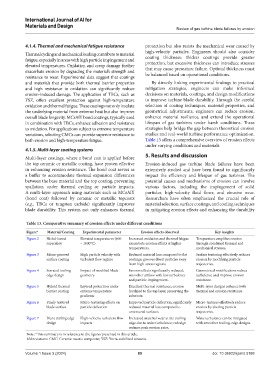
            both erosion and high-temperature fatigue.         Table 13 offers a comprehensive overview of erosion effects
                                                               under varying conditions and materials.
            4.1.5. Multi-layer coating systems
                                                               5. Results and discussion
            Multi-layer coatings, where a bond coat is applied before
            the top ceramic or metallic coating, have proven effective   Erosion-induced gas turbine blade failures have been
            in enhancing erosion resistance. The bond coat serves as   extensively studied and have been found to significantly
            a buffer to accommodate thermal expansion differences   impact the efficiency and lifespan of gas turbines. The
            between the base material and the top coating, preventing   potential causes and mechanisms of erosion can involve
            spallation under thermal cycling or particle impacts.   various factors, including the impingement of solid
            A multi-layer approach using materials such as MCrAlY   particles, high-velocity fluid flows, and abrasive wear.
            (bond coat) followed by ceramic or metallic topcoats   Researchers have often emphasized the crucial role of
            (e.g., TBCs or tungsten carbide) significantly improves   material selection, surface coatings, and cooling techniques
            blade durability. This system not only enhances thermal   in mitigating erosion effects and enhancing the durability

            Table 13. Comparative summary of erosion effects under different conditions

            Figure*  Material/Coating  Experimental parameter  Erosion effects observed     Key insights
            Figure 2  Nickel-based   Elevated temperatures (600   Increased oxidation and thermal fatigue   Temperature amplifies erosion
                     superalloy    – 1000°C)            exacerbate erosion effects at higher   through combined thermal and
                                                        temperatures.               mechanical stresses.
            Figure 3  Micro-grooved   High particle velocity with   Reduced material loss compared to flat   Surface texturing effectively reduces
                     surface coating  turbulent flow regime  coatings; grooves divert particles away   erosion by modifying particle
                                                        from high-stress regions.   trajectories.
            Figure 4  Serrated trailing   Impact of modified blade   Erosion effects significantly reduced;   Geometrical modifications reduce
                     edge design   geometry             smoother airflow with less turbulence   turbulence and improve erosion
                                                        and particle impingement.   resistance.
            Figure 5  Hybrid thermal   Layered protection under   Excellent thermal resistance; erosion   Multi-layer designs enhance both
                     barrier coating  extreme temperature   localized to the top layer, preserving the   thermal and erosion resistance.
                                   gradients            substrate.
            Figure 6  Finely textured   Micro-texturing effects on   Improved particle deflection; significantly  Micro-textures effectively reduce
                     blade surface  particle deflection  reduced material loss compared to   erosion by altering particle
                                                        untextured surfaces.        trajectories.
            Figure 7  Blunt trailing edge   High-velocity turbulent flow   Increased material wear at the trailing   Wake turbulence can be mitigated
                     design        impacts              edge due to wake turbulence; redesign   with smoother trailing-edge designs.
                                                        reduces peak erosion rates.
            Note: *This summary is in reference to the figures presented in this article.
            Abbreviations: CMC: Ceramic matrix composite; YSZ: Yttria-stabilized zirconia.


            Volume 1 Issue 3 (2024)                         89                             doi: 10.36922/ijamd.5188

