


Page 91 - IJAMD-1-3
P. 91
International Journal of AI for
            Materials and Design
                                                                            Review of gas turbine blade failures by erosion


            mitigation strategies and advanced protective measures   efficacy of these advanced TBC systems, demonstrating
            for  enhancing  the  resilience  and  durability  of  turbine   notable improvements in performance, as depicted in
            components. Their work also emphasizes the importance   Figure 4. Moreover, a predictive modeling technique for
            of accounting for particle size, velocity, and flow   estimating the lifespan of these turbine blade coatings was
            characteristics, providing a comprehensive framework   introduced, emphasizing the crucial aspect of mitigating
            for optimizing material selection and coating techniques.   erosion effects in high-temperature environments.
            By integrating these factors into predictive models,   Shin and Hamed  performed comprehensive
                                                                                   77
            engineers can anticipate erosion patterns more accurately   experiments to characterize the erosion resistance of
            and implement targeted design modifications to improve   plasma-sprayed 7 wt% YSZ TBCs applied on MCrAlY
            the longevity of turbine blades under extreme operating   bond coats and IN718 substrates, typically utilized in
            conditions.                                        GTE blade materials. Utilizing 26  µm particles, they
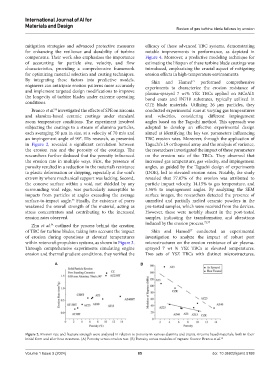
              Branco et al.  investigated the effects of SPE on zirconia   conducted experimental runs at varying gas temperatures
                        58
            and alumina-based ceramic coatings under standard   and velocities, considering different impingement
            room  temperature  conditions.  The  experiment  involved   angles based on the Taguchi method. This approach was
            subjecting the coatings to a stream of alumina particles,   adopted to develop an effective experimental design
            each averaging 50 µm in size, at a velocity of 70 m/s and   aimed at identifying the key test parameters influencing
            an impingement angle of 90°. His research, as presented   TBC erosion rates. Moreover, through the application of
            in  Figure  2, revealed a significant correlation between   Taguchi’s L9 orthogonal array and the analysis of variance,
            the erosion rate and the porosity of the coatings. The   the researchers investigated the impact of these parameters
            researchers further deduced that the porosity influenced   on the erosion rate of the TBCs. They observed that
            the  erosion  rate  in  multiple  ways.  First,  the  presence  of   increased gas temperature, gas velocity, and impingement
            porosity resulted in a reduction in the material’s resistance   angles, as guided by the Taguchi design of experiments
            to plastic deformation or chipping, especially at the void’s   (DOE), led to elevated erosion rates. Notably, the study
            extremity where mechanical support was lacking. Second,   revealed that 77.07%  of  the  erosion was  attributed  to
            the concave surface within a void, not shielded by any   particle impact velocity, 14.15% to gas temperature, and
            surrounding void edge, was particularly susceptible to   3.56%  to  impingement  angles.  By  analyzing  the  SEM
            impacts from particles at angles exceeding the average   surface images, the researchers detected the presence of
            surface-to-impact angle.  Finally, the existence of pores   unmelted  and  partially  melted  ceramic  powders  in  the
                                75
            weakened the overall strength of the material, acting as   pre-tested samples, which were received from the devices.
            stress concentrators and contributing to the increased   However, these were notably absent in the post-tested
            erosion rates observed.                            samples,  indicating  the  transformation  and  alterations
              Zhu  et al.  outlined the process behind the creation   induced by the erosion process. 72,77
                       58
            of TBC for turbine blades, taking into account the impact   Shin and Hamed  conducted an experimental
                                                                                  57
            of  erosion during operations at elevated temperatures   investigation to analyze the impact of robust port
            within rotorcraft propulsion systems, as shown in Figure 3.   microstructures on the erosion resistance of air plasma-
            Through comprehensive experiments simulating engine   sprayed 7 wt % YSZ TBCs at elevated temperatures.
            erosion and thermal gradient conditions, they verified the   Two  sets  of  YSZ  TBCs  with  distinct  microstructures,
                        A                                    B


            Figure 2. Erosion rate and fracture strength were analyzed in relation to porosity in various alumina and titania-zirconia based materials, both in their
            initial form and after heat treatment. (A) Porosity versus erosion rate. (B) Porosity versus modulus of rupture. Source: Branco et al. 58


            Volume 1 Issue 3 (2024)                         85                             doi: 10.36922/ijamd.5188

