


Page 92 - IJAMD-1-3
P. 92
International Journal of AI for
            Materials and Design
                                                                            Review of gas turbine blade failures by erosion


            characterized by porosities of 12.9 ± 0.5% and 19.5 ± 1.2%,   conditions. The study encompassed nine distinct factors
            were subjected to rigorous testing in a high-temperature   thoroughly examined and linked to their inclusive
            erosion tunnel designed to simulate the operational   abrasion performance and the root cause failure of turbine
            conditions of contemporary GTEs. The experimental trials   blades. Kedir  et al.  determined the minimal solidity
                                                                               78
            encompassed a temperature range spanning from 537°C   using a mass-volume system, while the matrix hardness
            to  980°C, with gas  velocities  ranging  between  122  m/s   was assessed through Vicker’s hardness of the matrix-rich
            and 305 m/s, and impingement angles spanning 20° – 90°.   region. Furthermore, the research emphasizes the necessity
            During the testing process, two types of powders were   of a systematic understanding of both material properties
            utilized, nominal 27 µm white fused alumina and 15 µm   and the operational environment. This approach is crucial
            A3, commonly known as test dust. The study concluded   in the development and assembling of abrasion-resilient
            that erosion rates increased in correspondence with gas   CMC  engine  materials  and  machineries,  ultimately
            velocities across all three impingement angles,  that is,   contributing to the improved reliability and strength of
            20°, 60°, and 90°. Furthermore, it was established that the   CMC hardware. It also highlights the need for rigorous
            experimental variations adhered to an empirical relation,   testing protocols to validate material performance
            emphasizing the importance of the relationship between   under realistic operating conditions, ensuring long-term
            the erosion rates and the tested parameters.       durability and efficiency.
              Kedir  et al.  conducted comprehensive tests on    Rajabinezhad  et al.  examined the primary factor
                         78
                                                                                  76
            various ceramic matrix composites (CMCs), employing   contributing to the failure of gas turbine blades composed
            different erodent particles at varying velocities ranging   of the Nimonic-105 nickel-based superalloy. Their
            between 200 m/s to 300 m/s under ambient temperature   investigation focused on two specific blades, one fractured
                                                               at the root and the other at the airfoil, delving into the
            A                      B                           intricate details to identify the underlying causes of these
                                                               failures. Images displaying the fracture surface of the root-
                                                               failed blade, captured using a stereomicroscope and SEM,
                                                               are depicted in Figure 5. They meticulously analyzed the
                                                               material properties and structural integrity of the blades
                                                               to gain a comprehensive understanding of the failure
                                                               mechanisms at play.  Figure  6 illustrates the fractured
                                                               surface of a gas turbine blade, which has become detached
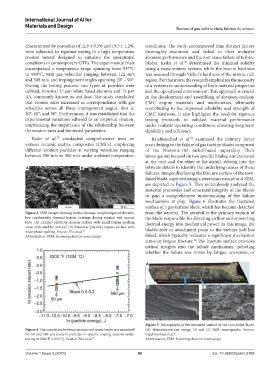
            Figure 3. SEM images showing surface damage morphologies of durable,   from the aerofoil. The aerofoil is the primary section of
            low conductivity thermal barrier coatings during erosion and impact   the blade responsible for directing airflow and converting
            tests. (A) Limited plasticity erosion surface with small fatigue spalling   thermal energy into mechanical power. In this image, the
            areas (indicated by arrows). (B) Extensive plasticity impact surface with   blade’s root or attachment point to the turbine hub has
            widespread spalling. Source: Zhu et al. 59
            Abbreviation: SEM: Scanning electron microscopy.   failed, which typically indicates a significant mechanical
                                                               stress or fatigue fracture.  The fracture surface provides
                                                                                   76
                                                               critical insights into the failure mechanism, including
                                                               whether the failure was driven by fatigue, corrosion, or

                                                               A


                                                               B                       C


                                                               Figure 5. Micrographs of the fractured surface of the root-failed blade.
            Figure 4. The correlation between erosion and impact rates was examined   (A) Stereomicroscope image. (B and C) SEM micrographs. Source:
            for 50 and 560 μm erodent particles in specific coating systems under   Rajabinezhad et al. 76
            testing at 2200 F (1204°C). Source: Zhu et al. 59  Abbreviation: SEM: Scanning electron microscopy.


            Volume 1 Issue 3 (2024)                         86                             doi: 10.36922/ijamd.5188

