


Page 94 - IJAMD-1-3
P. 94
International Journal of AI for
            Materials and Design
                                                                            Review of gas turbine blade failures by erosion


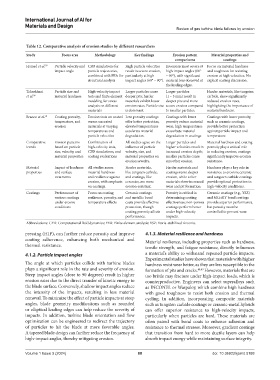
            Table 12. Comparative analysis of erosion studies by different researchers
            Study          Focus area    Methodology      Key findings     Erosion pattern   Material properties and
                                                                           comparisons          coatings
            Hamed et al. 55  Particle velocity and  CFD simulations for   High particle velocities   Erosion is most severe at  Focus on material hardness
                        impact angle  particle trajectories,   result in severe erosion,   high impact angles (60°   and toughness for resisting
                                      combined with FEA for  particularly at high   – 90°), with significant   erosion at high velocities. No
                                      structural analysis  impact angles (60° – 90°). material loss observed at  explicit coating discussion.
                                                                        the leading edges.
            Taherkhani    Particle size and   High-velocity impact   Larger particles cause   Larger particles   Harder materials, like tungsten
            et al. 56   material hardness  tests and finite element  deeper pits; harder   (1 – 5 mm) result in   carbide, show significantly
                                      modeling for stress   materials exhibit lower   deeper pits and more   reduced erosion rates,
                                      analysis on different   erosion rates. Particle size  severe erosion compared  highlighting the importance of
                                      materials       is dominant.      to smaller particles.  material hardness.
            Branco et al. 58  Coating porosity,   Erosion tests on coated  Low porosity coatings   Coatings with lower   Coatings with lower porosity,
                        temperature, and   versus uncoated   offer better protection;   porosity reduce material  such as ceramic coatings,
                        erosion       materials at varying   elevated temperatures   wear; high temperatures   provide better protection
                                      temperatures and   accelerate material   exacerbate material   against particle impact and
                                      particle velocities  degradation.  degradation in coatings.  temperature.
            Comparative   Erosion patterns   Combination of   All studies agree on the   Larger particles and   Material hardness and coating
            trends      based on particle   high-velocity tests,   influence of particle   higher velocities result in  porosity play a critical role
                        size, velocity, and   CFD simulations, and   velocity, size, and   increased erosion depth;  in reducing erosion; coatings
                        material properties  coating evaluations  material properties on   smaller particles cause   significantly improve erosion
                                                      erosion severity.  smoother erosion.  resistance.
            Material    Impact of hardness  All studies assess   Harder materials,   Harder materials and   Hardness plays a key role in
            properties  and surface   material hardness   like tungsten carbide,   coatings resist deeper   resistance to erosion; ceramic
                        treatments    and resilience against   and coatings, like   erosion, while softer   and tungsten carbide coatings
                                      erosion, with emphasis  ceramics, are more   materials show increased  provide optimal protection in
                                      on coatings.    erosion-resistant.  wear and pit formation.  high-velocity conditions.
            Coatings    Performance of   Focus on coating   Ceramic coatings   Porosity is critical in   Ceramic coatings (e.g., YSZ)
                        various coatings   resilience, porosity, and  and metallic bond   determining coating   and MCrAlY bond coatings
                        under erosive   temperature effects  coats provide effective   effectiveness; non-porous  provide superior performance,
                        conditions                    protection, though   coatings perform better   but porosity must be
                                                      coating porosity affects   under high-velocity   controlled to prevent wear.
                                                      performance.      impacts.
            Abbreviations: CFD: Computational fluid dynamics; FEA: Finite element analysis; YSZ: Yttria-stabilized zirconia.

            pressing (HIP), can further reduce porosity and improve   4.1.3. Material resilience and hardness
            coating  adherence,  enhancing  both  mechanical  and   Material resilience, including properties such as hardness,
            thermal resistance.                                tensile strength, and fatigue resistance, directly influences

            4.1.2. Particle impact angles                      a material’s ability to withstand repeated particle impacts.
                                                               Experimental studies have shown that materials with higher
            The  angle  at which particles  collide  with  turbine  blades   hardness resist wear better, as they are less susceptible to the
            plays a significant role in the rate and severity of erosion.   formation of pits and cracks. 48,49  However, materials that are
            Steep impact angles (close to 90 degrees) result in higher   too brittle may fracture under high-impact loads, which is
            erosion rates due to the direct transfer of kinetic energy to   counterproductive. Engineers can select superalloys such
            the blade surface. Conversely, shallow impact angles reduce   as INCONEL or Waspaloy, which combine high hardness
            the intensity of the impacts, resulting in less material   with good toughness to resist both erosion and thermal
            removal. To minimize the effect of particle impacts at steep   cycling. In addition, incorporating composite materials
            angles, blade geometry modifications such as rounded   such as tungsten carbide coatings or ceramic-metal hybrids
            or elliptical leading edges can help reduce the severity of   can offer superior resistance to high-velocity impacts,
            impacts. In addition, turbine blade orientation and flow   particularly when particles are hard. These materials are
            optimization can be engineered to redirect the trajectory   often paired with bond coats to enhance adhesion and
            of particles to hit the blade at more favorable angles.   resistance to thermal stresses. Moreover, gradient coatings
            A tapered blade design can further reduce the frequency of   that transition from hard to more ductile layers can help
            high-impact angles, thereby mitigating erosion.    absorb impact energy while maintaining surface integrity.


            Volume 1 Issue 3 (2024)                         88                             doi: 10.36922/ijamd.5188

