


Page 96 - IJAMD-1-3
P. 96
International Journal of AI for
            Materials and Design
                                                                            Review of gas turbine blade failures by erosion


            of turbine blades. 52,53  These studies typically encompass   enhanced erosion resistance, the application of advanced
            a comprehensive examination of erosion mechanisms,   coating systems, and the implementation of innovative
            failure modes, and the specific environmental conditions   cooling  techniques  to  manage  temperature  differentials
            contributing to erosion-induced damage. Discussions often   and reduce thermal stresses that can exacerbate erosion
            revolve around the development of advanced materials,   damage.
            including erosion-resistant super alloys, innovative coating   Moreover, it is probable that the review provides a critical
            technologies such as TBCs, and sophisticated cooling   appraisal of the latest advancements in computational
            strategies to manage the thermal stresses and protect the   modeling techniques, exploring how these tools have
            blades from erosion-related degradation. Furthermore,   revolutionized the understanding of erosion dynamics within
            discussions in such reviews often delve into the latest   gas turbine environments. Such discussions would likely
            advancements  in computational modeling techniques,   highlight the pivotal role of computational simulations, such
            including finite element method and CFD, enabling a   as FEA and CFD, in simulating complex erosion scenarios
            deeper understanding of the complex dynamics associated   and facilitating the design of robust mitigation strategies
            with erosion processes within gas turbine environments.  tailored to specific operating conditions and turbine
              Examining the critical aspects of gas turbine blade   configurations. This comprehensive review would serve as
            failures caused by erosion represents a significant   a valuable resource for researchers, engineers, and industry
            contribution to the ongoing efforts in the field of gas   professionals, offering in-depth insights and practical
            turbine technology and erosion management. By      guidance for addressing the persistent challenges associated
            scrutinizing the critical aspects and intricate nuances of   with  erosion-induced  gas turbine  blade failures.  The
            erosion-induced gas turbine blade failures, this review   integration of findings from this review into the development
            delves into the multifaceted nature of erosive processes,   of future research directions and practical applications could
            addressing the underlying mechanisms, key contributing   significantly  contribute  to the advancement of  erosion
            factors, and the implications of erosion on the overall   management strategies, ensuring enhanced performance,
            operational efficiency and longevity of gas turbines. In   durability, and reliability of gas turbine systems in diverse
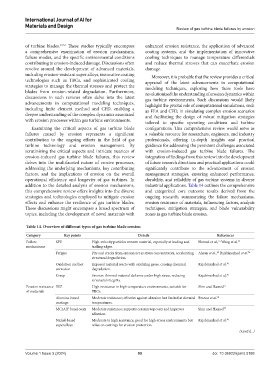
            addition to the detailed analysis of erosion mechanisms,   industrial applications. Table 14 outlines the comprehensive
            this comprehensive review offers insights into the diverse   and categorized core outcome results derived from the
            strategies and technologies employed to mitigate erosion   ongoing research, summarizing the failure mechanisms,
            effects and enhance the resilience of gas turbine blades.   erosion resistance of materials, influencing factors, analysis
            These discussions might encompass a broad spectrum of   techniques, mitigation strategies, and blade vulnerability
            topics, including the development of novel materials with   zones in gas turbine blade erosion.

            Table 14. Overview of different types of gas turbine blade erosion

            Category        Key points                      Details                          References
                                                                                              55
            Failure      SPE            High-velocity particles remove material, especially at leading and   Hamed et al.,  Wang et al. 33
            mechanisms                  trailing edges.
                         Fatigue        Pits and cracks from erosion act as stress concentrators, accelerating  Ahsan et al.,  Rajabinezhad et al. 76
                                                                                             49
                                        structural degradation.
                         Oxidation and hot   Exposed material reacts with oxidizing gases, causing chemical   Rajabinezhad et al. 76
                         corrosion      degradation.
                         Creep          Erosion-thinned material deforms under high stress, reducing   Rajabinezhad et al. 76
                                        structural integrity.
            Erosion resistance  YSZ     High resistance in high-temperature environments, suitable for   Shin and Hamed 57
            of materials                TBCs.
                         Alumina-based   Moderate resistance; effective against abrasion but limited at elevated  Branco et al. 58
                         coatings       temperatures.
                         MCrAlY bond coats  Moderate resistance; supports ceramic topcoats and improves   Shin and Hamed 77
                                        adhesion.
                         Nickel-based   Moderate to high resistance; good for high-stress environments but   Rajabinezhad et al. 76
                         superalloys    relies on coatings for erosion protection.
                                                                                                       (Cont'd...)


            Volume 1 Issue 3 (2024)                         90                             doi: 10.36922/ijamd.5188

