


Page 93 - IJAMD-1-3
P. 93
International Journal of AI for
            Materials and Design
                                                                            Review of gas turbine blade failures by erosion


            erosion-induced material weakening. The detachment   fractured blades. Corrosion and erosion emerged as
            of the blade from the aerofoil is a serious issue that   the predominant failure mechanisms, as deduced from
            compromises the turbine’s functionality and can lead   their comprehensive analysis. Through meticulous
            to catastrophic failure if undetected during operation.   investigation, they concluded that the initial failure
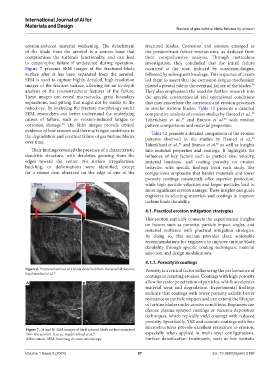
            Figure  7  presents SEM  images of  the fractured  blade   occurred at the root, induced by corrosion-fatigue,
            surface after it has been separated from the aerofoil.   followed by subsequent breakage. This sequence of events
            SEM is used to capture highly detailed, high-resolution   led them to assert that the corrosion-fatigue mechanism
            images of the fracture surface, allowing for an in-depth   played a pivotal role in the eventual failure of the blades.
                                                                                                            76
            analysis of the microstructural features of the failure.   They also emphasized the need for further research into
            These images can  reveal microcracks, grain boundary   the  specific  environmental  and  operational  conditions
            separations, and pitting that might not be visible to the   that may exacerbate the corrosion and erosion processes
            naked eye. By analyzing the fracture morphology under   in similar turbine blades.  Table  12 presents a detailed
            SEM, researchers can better understand the underlying   comparative analysis of erosion studies by Hamed et  al.,
                                                                                                            55
            causes of failure, such as erosion-induced fatigue or   Taherkhani  et  al.,  and Branco  et  al.  with erosion
                                                                              56
                                                                                                58
            corrosion damage.  The SEM images provide critical   pattern comparisons and material properties.
                           76
            evidence of how erosion and thermal fatigue contribute to   Table 12 presents a detailed comparison of the erosion
            the degradation and eventual failure of gas turbine blades   patterns observed in the studies by Hamed  et al.,
                                                                                                            55
            over time.
                                                               Taherkhani et al.,  and Branco et al.  as well as insights
                                                                             56
                                                                                             58
              Their findings revealed the presence of a characteristic   into  material  properties  and  coatings.  It  highlights  the
            dendritic  structure, with  dendrites growing  from the   influence of key factors such as particle size, velocity,
            edges toward the center. No surface irregularities,   material hardness, and coating porosity on erosion
            buckling,  or  deformations  were  identified,  except   behavior, with specific findings from each study. The
            for a minor dent observed on the edge of one of the   comparisons emphasize that harder materials and lower
                                                               porosity coatings consistently offer superior protection,
                                                               while high particle velocities and larger particles lead to
                                                               more significant erosion damage. These insights can guide
                                                               engineers in selecting materials and coatings to improve
                                                               turbine blade durability.
                                                               4.1. Practical erosion mitigation strategies
                                                               This section explicitly connects the experimental insights
                                                               on  factors  such  as porosity, particle  impact angles,  and
                                                               material resilience with practical mitigation strategies.
                                                               By doing so, this section provides clear, actionable
                                                               recommendations for engineers to improve turbine blade
                                                               durability through specific coating techniques, material
                                                               selection, and design modifications.

                                                               4.1.1. Porosity in coatings
            Figure 6. Fractured surface of a blade detached from the aerofoil. Source:   Porosity is a critical factor influencing the performance of
            Rajabinezhad et al. 76
                                                               coatings in resisting erosion. Coatings with high porosity
            A                       B                          allow for easier penetration of particles, which accelerates
                                                               material wear and degradation. Experimental findings
                                                               indicate that coatings with lower porosity exhibit better
                                                               resistance to particle impacts and can extend the lifespan
                                                               of turbine blades under erosive conditions. Engineers can
                                                               choose plasma-sprayed coatings or vacuum deposition
                                                               techniques, which typically yield coatings with reduced
                                                               porosity. Specifically, YSZ and ceramic coatings with fine
                                                               microstructures provide excellent resistance to erosion,
            Figure 7. (A and B) SEM images of the fractured blade surface separated
            from the aerofoil. Source: Rajabinezhad et al. 76  especially when applied in multi-layer configurations.
            Abbreviation: SEM: Scanning electron microscopy.   Surface densification treatments, such as hot isostatic


            Volume 1 Issue 3 (2024)                         87                             doi: 10.36922/ijamd.5188

