


Page 18 - IJAMD-2-1
P. 18
International Journal of AI for
            Materials and Design
                                                                             Predicting thermal conductivity of sintered Ag


                         A                                 B


            Figure 4. Finite element calculation results of the sintered nano-Ag microstructure. (A) Temperature cloud image of the model; and (B) heat flux density
            of each element in the y-direction.
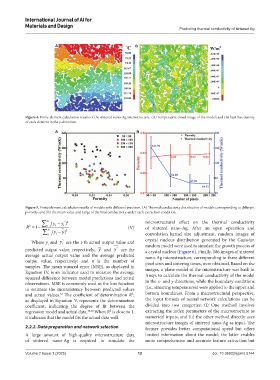
                         A                                 B


            Figure 5. Finite element calculation results of models with different precision. (A) Thermal conductivity distribution of models corresponding to different
            porosity; and (B) the mean value and range of thermal conductivity under each extraction condition.
                   ∑ n  (y − y *2                              microstructural effect on the thermal conductivity
                             )
            R = 1−   i= 1  i  i                        (V)     of  sintered  nano-Ag.  After  an  open  operation  and
             2
                   ∑ n i= 1 (y −  ) y  2                       convolution kernel size adjustment, random images of
                         i
                            *
              Where y  and  y  are the i-th actual output value and   crystal nucleus distribution generated by the Gaussian
                           i
                     i
                                                   *
            predicted output value, respectively;  y  and  y  are the   random model were used to simulate the growth process of
                                                               a crystal nucleus (Figure 6). Finally, 186 images of sintered
            average actual output value and the average predicted   nano-Ag microstructure, corresponding to three different
            output value, respectively; and  n is the number of   pixel sizes and sintering times, were obtained. Based on the
            samples. The mean squared error (MSE), as displayed in   images, a plane model of the microstructure was built in
            Equation IV, is an indicator used to measure the average   Ansys to calculate the thermal conductivity of the model
            squared difference between model predictions and actual
            observations. MSE is commonly used as the loss function   in the x- and y-directions, while the boundary conditions
            to estimate the inconsistency between predicted values   (i.e., sintering temperatures) were applied to the upper and
            and actual values.  The coefficient of determination R²,   bottom boundaries. From a microstructural perspective,
                           32
            as displayed in Equation V, represents the determination   the input formats of neural network calculations can be
            coefficient, indicating the degree of fit between the   divided into two categories: (i) One method involves
            regression model and actual data. 33,34  When R² is close to 1,   extracting the index parameters of the microstructure as
            it indicates that the model fits the actual data well.  numerical inputs, and (ii) the other method directly uses
                                                               microstructure images of sintered nano-Ag as input. The
            2.2.2. Data preparation and network selection      former provides better computational speed but offers
            A large amount of high-quality microstructure data   limited information about the model; the latter enables
            of  sintered  nano-Ag  is  required  to  simulate  the   more comprehensive and accurate feature extraction but

            Volume 2 Issue 1 (2025)                         12                             doi: 10.36922/ijamd.5744

