


Page 42 - IJAMD-2-3
P. 42
International Journal of AI for
            Materials and Design                                             Biomimetic ML for AFSD aluminum properties


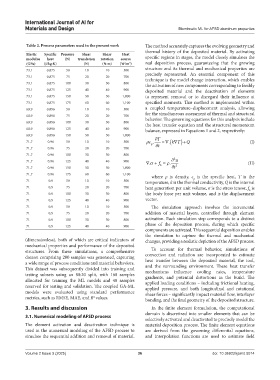
            Table 2. Process parameters used in the present work  The method accurately captures the evolving geometry and
                                                               thermal history of the deposited material. By activating
            Elastic   Specific  Pressure   Shear   Shear   Heat
            modulus   heat    (N)  translation   rotation   source   specific regions in stages, the model closely simulates the
            (GPa)   (J/kg·K)         (N)     (N·m)  (W/m )     real deposition process, guaranteeing that the growing
                                                        3
            73.1     0.875   50      10       10      500      structure and its thermal and mechanical properties are
            73.1     0.875   75      20       20      700      precisely represented. An essential component of this
                                                               technique is the model change interaction, which enables
            73.1     0.875   100     30       30      800      the activation of new components corresponding to freshly
            73.1     0.875   125     40       40      900      deposited material and the deactivation of elements
            73.1     0.875   150     50       50     1,000     to represent removal or to disregard their influence at
            73.1     0.875   175     60       60     1,100     specified moments. This method is implemented within
            68.9     0.896   50      10       10      500      a coupled temperature–displacement analysis, allowing
            68.9     0.896   75      20       20      700      for the simultaneous assessment of thermal and structural
            68.9     0.896   100     30       30      800      behavior. The governing equations for this analysis include
                                                               the heat transfer equation and the structural momentum
            68.9     0.896   125     40       40      900      balance, expressed in Equations 1 and 2, respectively:
            68.9     0.896   150     50       50     1,000          T
            71.7     0.96    50      10       10      500      c .    . kT   Q                      (I)
                                                                 p
            71.7     0.96    75      20       20      700           t
            71.7     0.96    100     30       30      800
                                                                           2
            71.7     0.96    125     40       40      900      .  f   .    u                         (II)
            71.7     0.96    150     50       50     1,000           b    t 2
            71.7     0.96    175     60       60     1,100       where  ρ is density,  c  is the specific heat,  T is the
                                                                                   p
            71        0.9    50      10       10      500      temperature, k is the thermal conductivity, Q is the internal
            71        0.9    75      20       20      700      heat generation per unit volume, σ is the stress tensor, f  is
                                                                                                           b
            71        0.9    100     30       30      800      the body force per unit volume, and is the displacement
            71        0.9    125     40       40      900      vector.
            71        0.9    50      10       10      500        The simulation approach involves the incremental
            71        0.9    75      20       20      700      addition of material layers, controlled through element
            71        0.9    100     30       30      800      activation. Each simulation step corresponds to a distinct
            71        0.9    125     40       40      900      phase of the deposition process, during which specific
                                                               components are activated. This sequential deposition enables
                                                               the simulation to capture the thermal and mechanical
            (dimensionless), both of which are critical indicators of   changes, providing a realistic depiction of the AFSD process.
            mechanical properties and performance of the deposited
            structures. From these simulations, a comprehensive   To account for thermal behavior, simulations of
            dataset comprising 200 samples was generated, capturing   convection and radiation are incorporated to estimate
            a wide range of process conditions and material behaviors.   heat transfer between the deposited material, the tool,
            This dataset was subsequently divided into training and   and the surrounding environment. These heat transfer
                                                               mechanisms influence cooling rates, temperature
            testing subsets using an 80:20 split, with 160  samples   gradients, and potential distortions in the build. The
            allocated for training the ML models and 40  samples   applied loading conditions – including frictional heating,
            reserved for testing and validation. The coupled GA-ML   applied pressure, and both longitudinal and rotational
            models were evaluated using standard performance   shear forces – significantly impact material flow, interlayer
            metrics, such as RMSE, MAE, and R  values.         bonding, and the final geometry of the deposited structure.
                                         2
            3. Results and discussion                            In the finite element formulation, the computational
                                                               domain is discretized into smaller elements that can be
            3.1. Numerical modeling of AFSD process
                                                               selectively activated and deactivated to precisely model the
            The element activation and deactivation technique is   material deposition process. The finite element equations
            used in the numerical modeling of the AFSD process to   are derived from the governing differential equations,
            simulate the sequential addition and removal of material.   and interpolation functions are used to estimate field


            Volume 2 Issue 3 (2025)                         36                             doi: 10.36922/ijamd.5014

