


Page 43 - IJAMD-2-3
P. 43
International Journal of AI for
            Materials and Design                                             Biomimetic ML for AFSD aluminum properties


            variables (e.g., temperature and displacement) within each   The use of the element activation and deactivation
            element. An implicit temporal integration approach is   technique in the numerical model enables accurate
            widely employed to enhance numerical stability in coupled   simulation of the dynamic nature of the AFSD process.
            thermo-mechanical analyses. Accurate simulation also   This method provides valuable insights into the thermal
            requires the application of adequate boundary and initial   and mechanical behavior of the deposited material, aiding
            conditions.                                        in the prediction of material properties, the identification
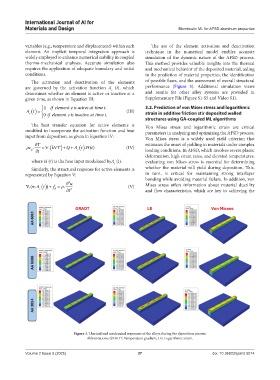
              The activation and deactivation of the elements   of possible flaws, and the assessment of overall structural
            are governed by the activation function  A  (t), which   performance (Figure  3). Additional simulation views
                                                c
            determines whether an element is active or inactive at a   and results for other alloy systems are provided in
            given time, as shown in Equation III:              Supplementary File (Figure S1-S5 and Video S1).
                     1  if elemente is active at time t.     3.2. Prediction of von Mises stress and logarithmic
            At                                     (III)   strain in additive friction stir deposited walled
             c
                     0  if elemente is inactive at timme t.  structures using GA-coupled ML algorithms
              The heat transfer equation for active elements is   Von Mises stress and logarithmic strain are critical
            modified to incorporate the activation function and heat   parameters in analyzing and optimizing the AFSD process.
            input from deposition, as given in Equation IV:    Von  Mises  stress  is  a  widely  used  yield  criterion  that

                 T                                            estimates the onset of yielding in materials under complex
            c .  t    . kT   QA tH t.( )    (IV)    loading conditions. In AFSD, which involves severe plastic
              p
                                  c
                                                               deformation, high strain rates, and elevated temperatures,
              where H (t) is the heat input modulated byA  (t).  evaluating von Mises stress is essential for determining
                                                  c
              Similarly, the structural response for active elements is   whether the material will yield during deposition. This,
            represented by Equation V:                         in turn, is critical for maintaining strong interlayer
                                                               bonding while avoiding material failure. In addition, von
                              2
                              u                               Mises stress offers information about material ductility
                    )
            .( . At   f b   .  t 2                (V)     and flow characteristics, which are key to achieving the
                  c


                                 Figure 3. Thermal and mechanical responses of the alloys during the deposition process
                                      Abbreviations: GRADT: Temperature gradient; LE: Logarithmic strain.


            Volume 2 Issue 3 (2025)                         37                             doi: 10.36922/ijamd.5014

